
Jiu-Jitsu turns confidence into a repeatable practice you can carry from the mats into meetings, commutes, and family life.
If you live in Maplewood, you already know the pace can swing fast: a busy morning, a full workday, a tight pickup window, then trying to be present at home. In that kind of schedule, confidence and focus are not abstract qualities. We either train them, or we run on fumes and hope willpower shows up on time.
That is why we like talking about Jiu-Jitsu as a habit builder, not just a martial art. Around the world, participation has grown into the millions and continues climbing year over year, which tracks with what adults want: a realistic way to get stronger, sharper, and more resilient without needing to be a “gym person” first.
In our adult program, we see the same pattern again and again. You learn a skill under real resistance, you notice your stress response, and you practice making calm decisions anyway. That process looks physical on the outside, but the payoff is often mental: better focus, steadier confidence, and a more grounded day-to-day baseline.
Why Jiu-Jitsu builds usable confidence, not just “hype”
Confidence feels great when you get it from compliments or a good day. The problem is that kind of confidence can disappear the moment your environment changes. Jiu-Jitsu trains a different kind: confidence under pressure, earned through repetition and feedback.
The key ingredient is live practice. When you drill a technique, you learn the idea. When you apply it against a resisting partner, you learn yourself. You find out what you default to when you are tired, when you are pinned, or when something is not working. Then you adjust.
Research and participant reports increasingly connect Brazilian Jiu-Jitsu training with improved mood, lower anxiety, better concentration, and stronger commitment to goals. That lines up with what adults tell us after a few weeks: it is not only that you feel more capable on the mats, you start walking through normal life with less internal noise.
The Maplewood adult-life advantage: training that fits real schedules
Adults do not need another obligation that becomes a guilt trip. You need something sustainable. Our approach is built around consistency, and our class schedule is designed to work for commuters, parents, and professionals who want a routine that actually sticks.
There is also a subtle benefit to training locally: you stop treating stress management like a theoretical self-improvement project. It becomes practical. You finish class, you head back into Maplewood life, and you get immediate reps applying calmer breathing, better posture, and clearer decision-making in everyday situations.
Habit 1: Show up even when you do not feel “ready”
A common barrier for adults is thinking you must be in shape before starting. In reality, training is how you get in shape. Our job is to meet you where you are, keep the learning curve manageable, and help you build momentum without burning out.
Showing up is a skill, and Jiu-Jitsu reinforces it quickly because progress is measurable. You feel the difference between week one and week four. Your movements become less frantic. Your timing improves. And when you notice improvement, you start trusting your ability to follow through.
This habit transfers cleanly into work and home life. You stop waiting for perfect conditions. You get comfortable starting, adjusting, and finishing.
Habit 2: Stay calm under pressure by practicing it on purpose
Most adults are not stressed because they lack information. You are stressed because you have too much input, too many responsibilities, and too little recovery. On the mats, pressure is literal. Someone is trying to control you, and you cannot “think your way out” without using your body.
We coach you to slow down your breathing, protect your posture, and choose one small goal at a time. That might be recovering guard, improving a frame, or getting back to your knees. These micro-decisions teach your nervous system a new default: do not panic, prioritize, execute.
Over time, you start noticing the same shift off the mats. The email inbox spike, the tense conversation, the traffic jam. You cannot always control the situation, but you can control your response.
Habit 3: Solve problems when you are tired, not only when you are fresh
Real life rarely asks you to make decisions at your best. You make decisions at the end of the day, after responsibilities, when your brain wants to take shortcuts. Jiu-Jitsu is honest about that. Sparring rounds happen when you are already working.
That is where focus improves. You learn to keep thinking while your heart rate is up. You practice finding simple solutions instead of complicated ones. You learn which grips, positions, and transitions give you the most leverage for the least effort.
Competitive events continue to show strong adult participation and high submission rates, which reflects how technically deep the sport is. But you do not need to compete to benefit from that depth. Every class gives you a controlled environment to practice decision-making under fatigue, and that is a rare kind of training.
Habit 4: Build body awareness that carries into posture and energy
Many adults walk around disconnected from their bodies. Long hours sitting, shoulders creeping up, shallow breathing, stiff hips. Jiu-Jitsu brings you back into alignment because leverage requires awareness.
You learn how to place your weight, how to base, how to move your hips, and how to keep your spine safer under load. Even small improvements show up outside the gym. You stand a little taller. You feel more balanced. You waste less energy.
We also see this help with confidence in a simple way: when your posture improves, your mind often follows. You take up your space more naturally, without forcing it.
Habit 5: Win small, often, and let that rebuild your self-trust
Adults sometimes expect learning to feel smooth. It does not. You will have awkward reps. You will forget steps. You will tap out. And then you will do one thing better than last time, and it matters.
Jiu-Jitsu rewards small wins:
- You remember a grip that worked last class and you use it again at the right time
- You stay calm in a bad position and recover instead of freezing
- You escape a hold that used to feel impossible
- You last a full round without holding your breath
- You ask a question, get clarity, and apply the answer immediately
Those wins are not flashy, but they are real. Over weeks, they stack into something powerful: self-trust. That is the foundation of confidence that lasts longer than a motivational quote.
What to expect in our Adult Jiu-Jitsu classes in Maplewood
Adults usually want a clear picture before stepping onto the mats. Our classes are structured, coached, and designed for learning, not for chaos. You will warm up, drill techniques with a partner, and then do controlled rounds that help you apply the skill under pressure.
We emphasize no-gi training because it is practical, athletic, and straightforward for many adults. No-gi also keeps the focus on body mechanics, positioning, and control without relying on jacket grips. If your goal includes real-world applicability, no-gi grappling is a clean fit.
You do not need prior experience. You do not need to be flexible. You do not need to “tough it out” through pain. You do need curiosity, consistency, and the willingness to learn one step at a time.
How often should an adult train to feel the benefits?
For most adults, the best plan is the one you can sustain. If you train once a week, you can learn and feel better. If you train two to three times per week, you will usually notice faster changes in conditioning, confidence, and focus. More than that can be great too, but only if recovery and schedule allow it.
If you are starting from scratch, we often recommend building a simple rhythm first. Consistency beats intensity. A steady routine is where stress resilience comes from.
Here is a practical progression many adults use:
1. Start with one or two classes per week for the first month to learn the basics and adapt
2. Add a third class if your body feels good and your schedule stays realistic
3. Protect one full rest day, and prioritize sleep so your progress does not stall
4. Track one small goal per week, like breathing calmer in rounds or improving a specific escape
5. Reassess every four weeks and adjust based on energy, not guilt
Beginner FAQ for adults who are curious but cautious
Is Jiu-Jitsu good for beginners as an adult?
Yes. Adult beginners are a major entry point in modern Jiu-Jitsu, and our coaching is built to make the learning curve manageable from day one.
Do I need to be in shape before starting?
No. Training builds conditioning gradually. We scale intensity, and you can take breaks when needed. The goal is progress, not perfection.
What should I wear to my first class?
Wear comfortable athletic clothing that allows movement. If you are unsure, check the website for guidance and show up a little early so we can help you get set.
Is it safe for older adults or people returning to exercise?
We keep training controlled and emphasize tapping early, learning proper mechanics, and communicating with partners. Adults of many ages start safely when the environment is coached and respectful.
How long does it take to feel more confident?
Many people feel a shift within a few weeks, mainly from learning how to breathe and problem-solve under pressure. Deeper confidence builds over months as skills become reliable.
What is the difference between Adult Jiu-Jitsu in Maplewood and Adult Grappling classes?
In practice, both focus on controlling an opponent, escaping bad positions, and applying submissions safely. We use clear skill progressions so you understand not just what to do, but why it works.
Take the Next Step at Bodega Jiu-Jitsu
The habits that come from training are not theoretical. When you practice staying calm under pressure, showing up consistently, and solving problems while tired, you build a kind of confidence that holds up on a hectic Tuesday, not only on a great day.
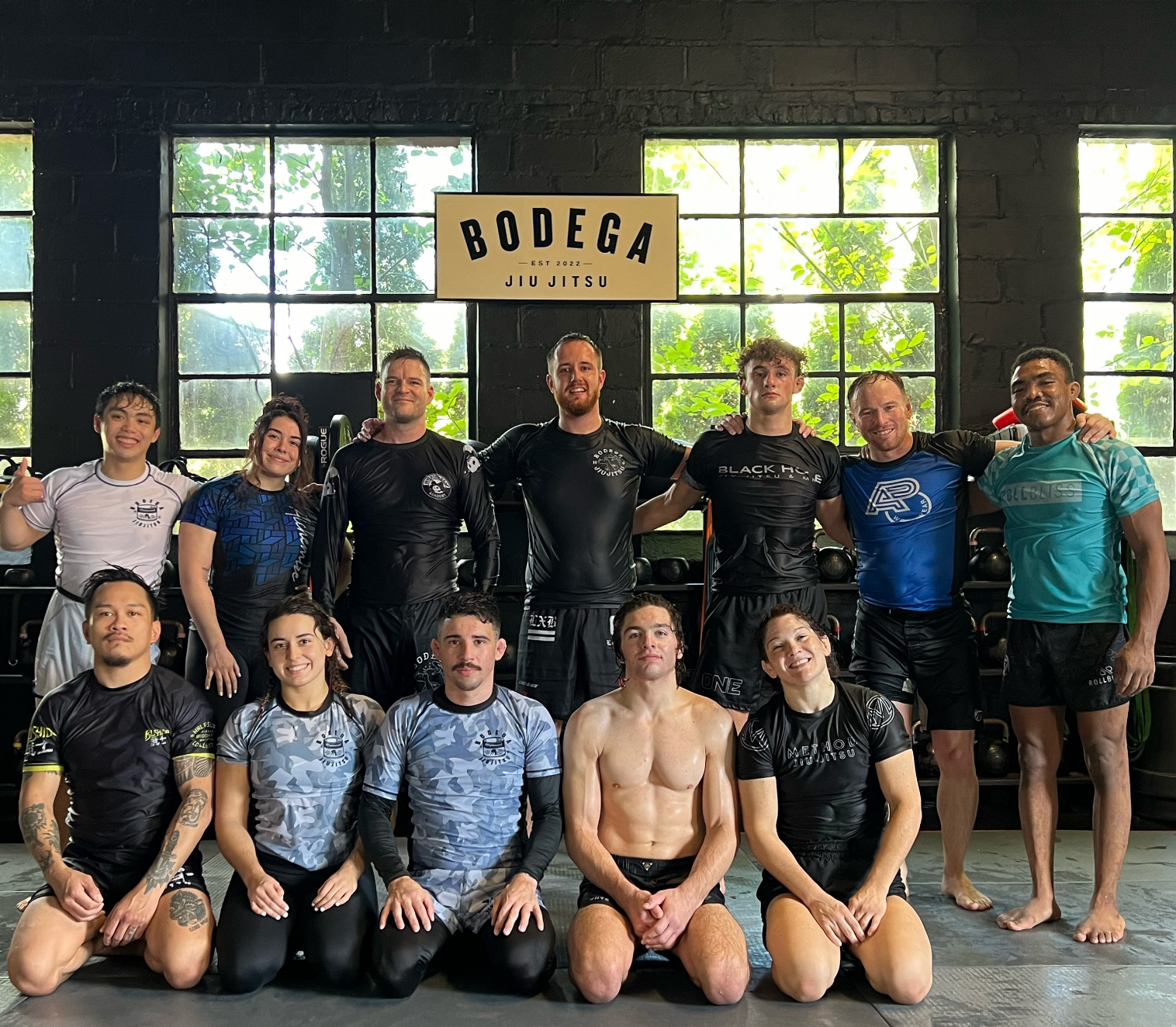
At Bodega Jiu-Jitsu, we designed our Adult Jiu-Jitsu in Maplewood to be practical, welcoming to beginners, and structured so your focus and stress resilience improve week by week. If you are looking for Adult Grappling classes that fit real life and produce real carryover, we are ready when you are.
Move from reading to rolling to join a grappling program at Bodega Jiu Jitsu today.