
Training is where you practice staying calm, thinking clearly, and recovering fast when life gets messy.
Adult Jiu-Jitsu is often described as a workout, but what surprises most new students is how quickly it becomes a mental skill set. When you train regularly, you spend a lot of time solving problems under pressure, managing nerves, and adjusting when Plan A falls apart. That combination is exactly what builds mental agility and resilience.
Here in Maplewood, life moves fast. Work stress, commuting, family responsibilities, and the general noise of daily life can leave you feeling like your attention is fragmented. In our Adult Jiu-Jitsu in Maplewood, NJ program, we focus on giving you a place to reset your mind while learning something practical. You get a challenge, a community, and a structured way to improve week to week.
Why Adult Jiu-Jitsu builds mental agility (not just technique)
Mental agility is the ability to perceive what is happening, decide what matters, and respond without freezing. On the mats, you practice that in a very real way. Positions change quickly, and you do not get unlimited time to think through a perfect answer. You learn to read cues and act.
Adult Jiu-Jitsu forces you to develop pattern recognition. After enough rounds, you start noticing the early signals: where weight is shifting, where pressure is building, what grip or underhook is coming next. That is not magic. It is your brain getting sharper at filtering information and making decisions.
The best part is that you can feel this skill transferring outside the gym. You start catching yourself before you spiral, before you snap, before you procrastinate. Not every day, of course, but more often than before. That is what progress tends to look like for adults: subtle, then obvious.
Rolling is problem-solving with feedback you cannot ignore
In many hobbies, feedback is delayed. In jiu-jitsu, feedback is immediate. If you leave space, you get passed. If you rush, you get off-balanced. If you hold your breath, you burn out. That instant cause-and-effect loop is a powerful teacher.
Rolling also teaches you to prioritize. In a scramble, ten things are happening, but only one or two actually matter. Adult Jiu-Jitsu trains you to identify the lever that changes everything, like posture, inside position, frames, or angle. Over time you get calmer because you understand what to do first.
Resilience: how you learn to recover after mistakes
Resilience is not pretending you never struggle. It is being able to stay engaged when something goes wrong, then come back the next round with a better plan. Jiu-jitsu offers constant, controlled exposure to small failures, which is oddly freeing once you get used to it.
A normal training night includes getting stuck, tapping, forgetting a step, or realizing you are doing something backwards. Instead of spiraling, you learn to treat mistakes as data. You ask a question, make a tweak, and try again. That is resilience in action.
Recent research lines up with what many long-time practitioners report: more experienced Brazilian jiu-jitsu athletes tend to score higher in resilience-related traits like mental strength, self-control, self-efficacy, grit, and even life satisfaction, with lower mental health disorder scores reported among the most experienced groups. That does not mean training is a cure or a guarantee, but it does support the idea that consistent practice builds a sturdier inner toolkit.
The quiet confidence effect
Adult Jiu-Jitsu builds a particular kind of confidence. It is not loud. It is not performative. It comes from knowing you can stay composed when a situation gets uncomfortable, whether that is a tough conversation at work or a stressful moment in public.
That confidence grows because you practice. You learn how to breathe under pressure. You learn that you can be tired and still think. You learn you can reset after a bad round and keep going. That is a skill, and it is trainable.
Why no-gi training can feel more approachable for adults
A lot of adults in Maplewood want something practical and beginner-friendly, and no-gi can be an easier entry point. Without the gi, you do not have to think about lapel grips, belt tying, or a uniform right away. You can focus on movement, balance, control, and basic positional goals.
No-gi also tends to feel intuitive for self-defense and real-world scenarios because you are learning to control a body without relying on clothing grips. That does not make it better than gi, just different, and for many first-timers it lowers the barrier to showing up.
In our Adult Jiu-Jitsu in Maplewood program, we keep the learning curve manageable. You will hear new terms, sure, but we teach in a way that connects the idea to what your body is doing, so you are not just memorizing steps.
What a complete beginner can expect in an Adult Jiu-Jitsu class
Most adults worry about the same things before the first class: Will I be totally lost? Am I in bad shape? Is everyone going to be intense? The truth is that beginners are the norm, and our job is to guide you through a progressive process.
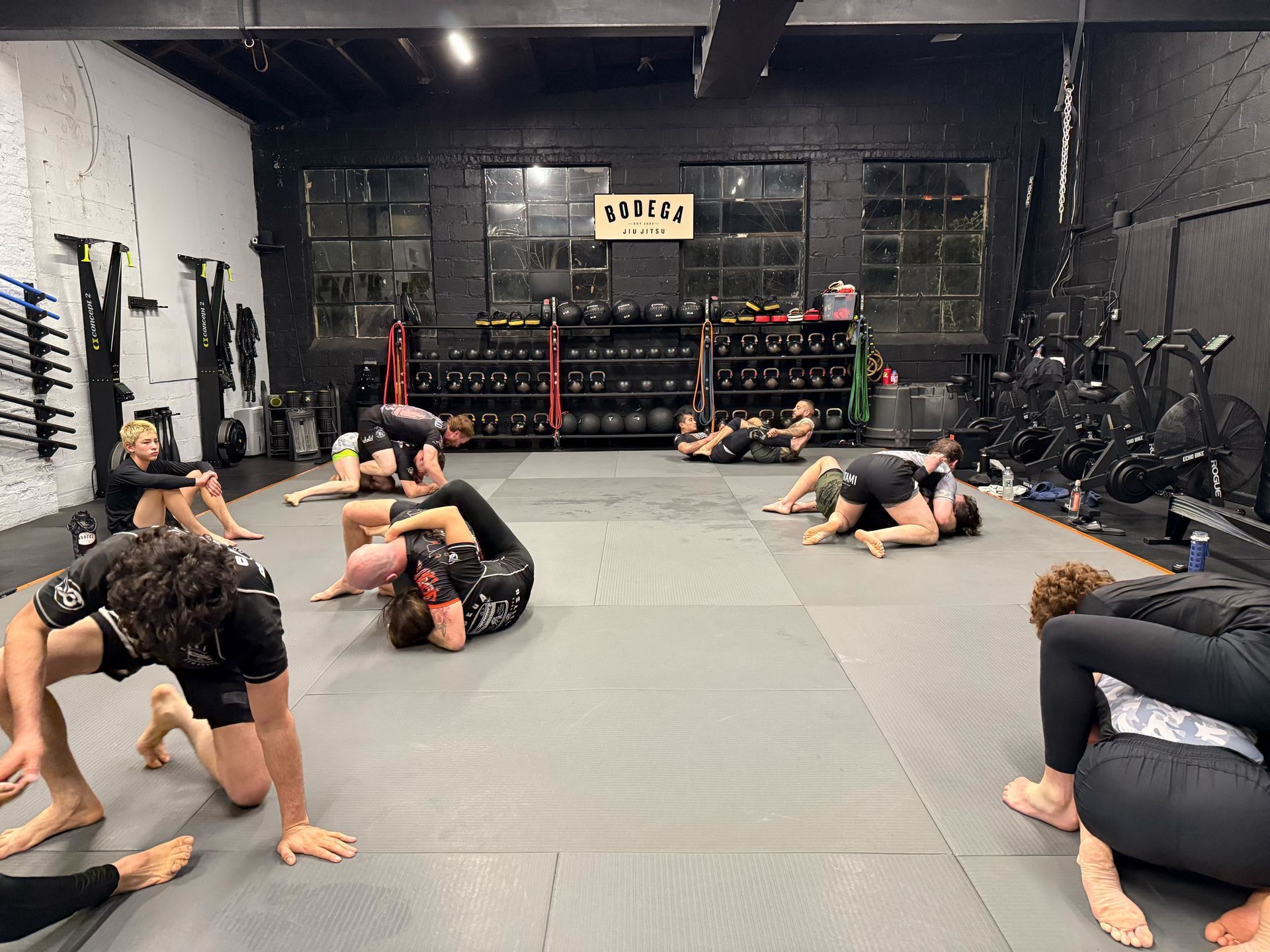
You can expect a warm-up focused on useful movement, not random punishment. Then we teach a small set of techniques with a clear purpose, like escaping a bad position, maintaining top control, or getting back to guard. After that, you will usually drill with a partner, and we help you troubleshoot.
Controlled sparring, when you are ready for it, is introduced gradually. That matters because intensity is what often scares adults away. Our goal is development, not chaos.
Here is what that beginner progression typically looks like:
1. Learn basic movement and safety habits, including tapping early and communicating clearly
2. Understand positional goals like guard, side control, mount, and back control
3. Drill techniques at a steady pace with coaching and repetition
4. Add light positional sparring so you can practice without feeling overwhelmed
5. Build toward fuller rounds as your comfort, timing, and conditioning improve
This structure is one reason Adult Jiu-Jitsu stays sustainable for busy adults. You are not thrown into the deep end on day one.
Mental focus benefits you notice outside the gym
Adult Jiu-Jitsu can sharpen focus in a way that feels different from a normal workout. Because you are interacting with another person, you cannot check out mentally. Your attention is either present or you get swept, passed, or pinned. That demand for real-time focus becomes a kind of practice for your brain.
Over time, many students notice improvements like:
• Better ability to concentrate on one task at a time
• Less rumination, because your mind has a physical outlet for stress
• Improved emotional regulation when something frustrating happens
• More patience with learning curves in other areas of life
• A clearer sense of progress, because skills develop in visible stages
Those are not overnight changes. They build through consistent, imperfect training. Some nights feel amazing, some nights feel clunky, and both are useful.
Training frequency: how often adults should train for mental benefits
If your goal is mental agility and resilience, consistency matters more than intensity. For many adults, two classes per week is a strong starting point. It is enough repetition to build familiarity without turning training into another stressor.
If you can train three times per week, progress tends to accelerate because you stay connected to the positions and concepts. Once per week can still help, especially for stress relief, but it may feel slower because your body and brain need repetition to hold onto details.
The biggest win is choosing a schedule you can actually maintain. Adult Jiu-Jitsu should support your life, not compete with it.
Safety, accessibility, and the honest answer about being out of shape
You do not need to be athletic to start. You need to be willing to learn and communicate. We scale intensity, match partners thoughtfully, and emphasize technique so you are not relying on strength or speed.
Safety in Adult Jiu-Jitsu is a team effort. We tap early. We avoid ego-driven rounds. We treat injuries and soreness with common sense. If you are older, returning to fitness, or managing old aches, we can adjust training so you build capacity gradually.
A practical note: soreness happens, especially at first. It is not a sign you are failing. It is usually just your body adapting to new movement patterns. Hydrate, sleep, and give yourself a couple weeks to settle in.
What to wear to your first class (simple and low-stress)
For no-gi Adult Jiu-Jitsu, you can start with basics you may already own. Aim for athletic clothing that fits close enough to avoid snagging.
Bring or wear:
• Rash guard or fitted athletic shirt
• Grappling shorts or regular gym shorts without pockets or zippers
• Flip-flops for walking off the mat area
• Water bottle and a small towel
• A calm mindset, because nobody expects perfection
If you have questions about gear, we can walk you through it before class. The goal is to make starting easy.
Why Maplewood adults keep training once they start
People begin Adult Jiu-Jitsu for different reasons: stress relief, self-defense, fitness, curiosity. What keeps most adults coming back is the feeling of capability. You solve real problems with your body and brain, in a supportive environment, and you can measure progress in a way that is hard to fake.
There is also a community element that matters more than people expect. Training partners become familiar faces. You learn each other’s styles. You encourage each other through plateaus. For adults who spend all day in meetings or on screens, that human connection is grounding.
And there is a practical side. Knowing how to control distance, posture, and balance changes how you carry yourself. Adult Jiu-Jitsu in Maplewood, NJ is not about looking for conflict. It is about feeling prepared and steady.
Take the Next Step
If you want a training routine that strengthens your mind as much as your body, our adult no-gi program is built for that. You will practice problem-solving under pressure, learn to stay composed in hard moments, and develop the kind of resilience that shows up when life gets demanding.
At Bodega Jiu-Jitsu, we keep Adult Jiu-Jitsu welcoming and structured, with clear coaching and a beginner-friendly approach at our Maplewood location at 6 West Parker Ave, Maplewood, NJ. When you are ready, we will help you start smart, train safely, and build real momentum.
Ready to train? Join a Jiu-Jitsu class at Bodega Jiu-Jitsu and start building your skills.