


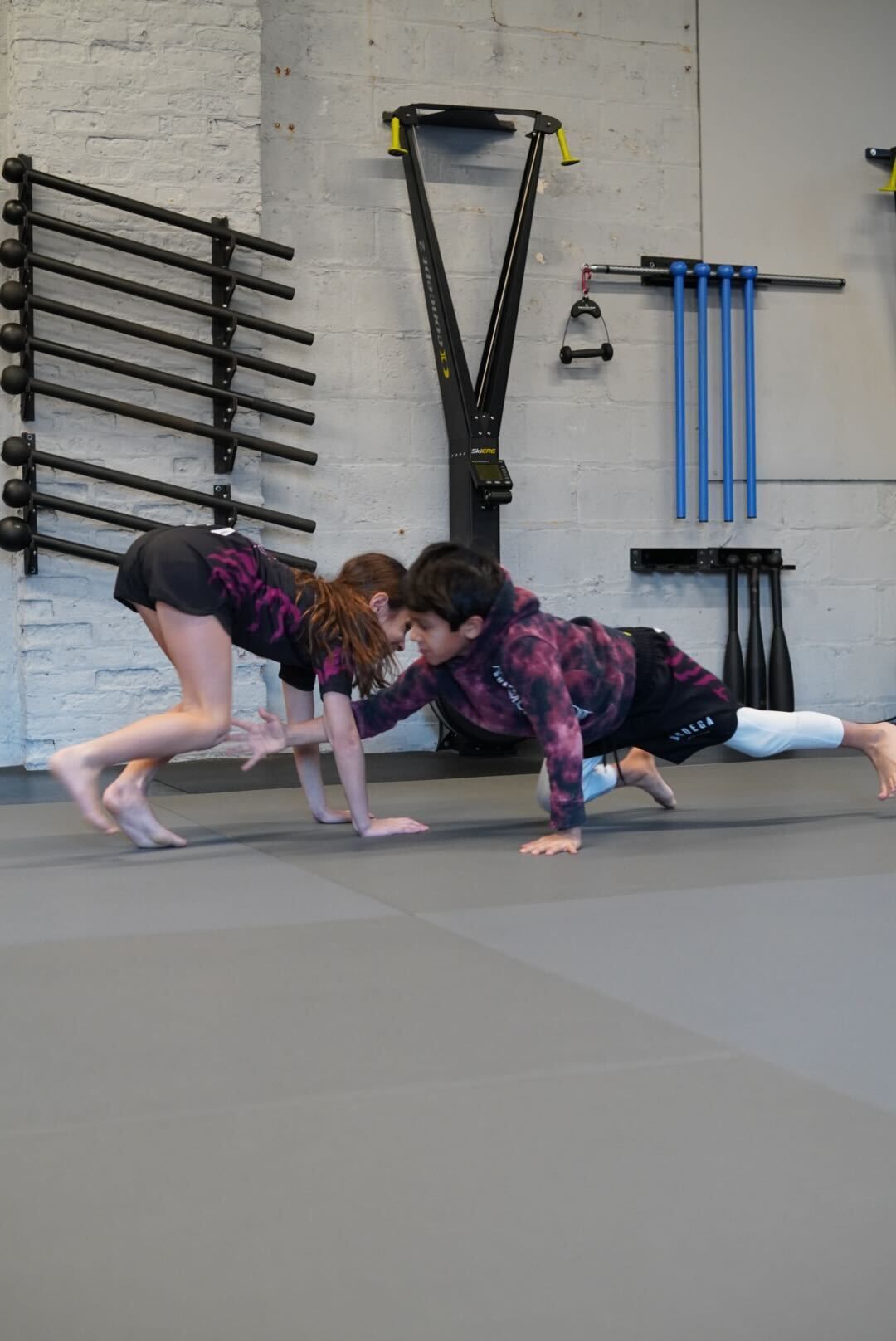
Youth Jiu-Jitsu gives kids a place to move, think, and grow confident, without turning training into a fight culture.
Finding an after school activity in Maplewood that your child actually wants to do, week after week, can feel like a small miracle. Youth Jiu-Jitsu tends to work for a lot of families because it mixes movement, structure, and just enough challenge to keep kids engaged.
We also like that it is not purely a team sport and not purely an individual activity. In class, your child learns personal responsibility, but also learns how to work with partners respectfully, communicate clearly, and reset after mistakes. That combination is a big part of why Youth Jiu-Jitsu in Maplewood keeps growing in popularity.
Nationally, kids are busy, but participation is not equal across ages and households. Federal data from 2023 to 2024 found 56.7 percent of U.S. children ages 6 to 17 participated in a sports team or lesson in the previous year, with participation highest among ages 9 to 14 and lower among ages 15 to 17. That context matters, because the right program has to fit your child’s stage, energy, and attention span, not just your calendar.
What Youth Jiu-Jitsu actually teaches kids
People sometimes assume jiu-jitsu is mainly about winning a match. In youth classes, our focus is more foundational: body awareness, safe contact, and problem solving while staying calm. Youth Jiu-Jitsu works because it is learned through controlled resistance, meaning kids practice with a real partner who moves, pushes back a little, and forces them to adapt.
Movement skills that show up everywhere
Before we even talk about self-defense, we teach movement: how to fall safely, how to base out, how to keep balance when someone nudges or pulls, and how to move the hips and shoulders as a connected unit. For younger kids, that can look like playful drills. For older kids, it becomes more technical and precise.
These skills carry into other activities, too. Kids often move better in general once they learn how to coordinate their body under pressure, even mild pressure.
Positions, escapes, and choices
Youth Jiu-Jitsu is less about trading hits and more about learning positions and pathways out of them. Kids learn what it means to be pinned, what “frames” are (using arms and legs like supportive structures), and how to create space. That phrase “create space” comes up a lot, because it is a practical goal a child can remember.
Instead of memorizing a long sequence, we teach simple decision trees:
If you are here, try this.
If your partner does that, switch to this.
If you cannot move, breathe, frame, and rebuild your base.
That is problem solving, not choreography, and kids tend to like that it feels like a puzzle.
Respect and emotional control, built into the rules
A well run class makes respect non negotiable, not as a speech, but as a daily habit. The small rituals matter: greeting coaches, listening the first time, taking turns, and treating partners like teammates even when you are practicing against each other.
And tapping is a big deal. When kids learn to tap, and when kids learn to immediately release on a tap, we are teaching communication, boundaries, and responsibility in a very concrete way.
Why kids have fun doing it (and keep coming back)
Youth programs succeed when kids feel progress they can notice. In Youth Jiu-Jitsu, progress shows up quickly: a child who could not shrimp down the mat last month suddenly moves smoothly, or a child who used to panic under a light pin learns to breathe and escape.
We build fun into the structure. A typical class blends instruction with active games and situational rounds that feel like challenges rather than tests. It is active, but it is also thoughtful. Some kids love that they get to move constantly. Other kids love that there is a clear “why” behind each drill.
A few reasons many kids enjoy training:
- It feels like learning a skill, not just burning energy, so kids stay mentally engaged.
- Partner drills create instant social connection, even for shy kids, because the activity gives them a shared task.
- The techniques scale, meaning a smaller child can succeed with timing and position, not just strength.
- There is variety, so class does not feel like the same practice on repeat.
This is part of why families looking beyond standard team sports often end up exploring Youth Jiu-Jitsu in Maplewood, NJ. It gives kids an individual growth path, but inside a supportive group.
Self-defense beyond fighting: realistic, age-appropriate goals
Parents often search Youth Jiu-Jitsu because the word “self-defense” matters. We agree, but we frame it realistically. A kids program should not promise that a child will “win” against a bigger attacker, and we do not teach kids to look for confrontation.
Self-defense for kids is usually about a few practical outcomes:
Stay composed, even when surprised.
Protect personal space.
Create space and get away.
Get to an adult and communicate clearly.
The self-defense lesson most parents appreciate: leaving is success
In youth training, a clean escape and disengagement is a win. If a child can break a grip, move their feet, and get distance while staying calm, that is meaningful. We pair that with “what next,” which often means finding a teacher, parent, coach, or another trusted adult right away.
Bullying: skills help, but adults must lead
Youth Jiu-Jitsu can help a child practice composure, posture, and boundaries. It can also help kids feel less helpless if someone grabs them or crowds them. But it is not a replacement for adult intervention or a school’s anti-bullying process.
We encourage a simple, repeatable plan:
Use your voice clearly.
Step away and create distance.
If grabbed, break the grip and move away.
Tell a trusted adult as soon as you can.
That is a realistic message, and it keeps the emphasis where it belongs: safety and support, not ego.
Safety in Youth Jiu-Jitsu: how we build a controlled environment
No physical activity is risk free, and we never pretend it is. What we can do is reduce avoidable risk with strong supervision, clear rules, and age appropriate intensity.
Our safety approach is practical and consistent:
We match partners thoughtfully, paying attention to size, maturity, and temperament.
We teach tapping early, and we require immediate release on a tap, every time.
We build warmups that prepare joints and muscles for grappling movement.
We keep live training controlled and purposeful, not chaotic.
We maintain hygiene standards that make training cleaner and more comfortable.
One detail parents often notice is that controlled resistance does not mean full intensity. It means a coach chooses the right level of pushback for the drill. Some days a child needs more structure and slower reps. Other days, once the basics are stable, we let kids test skills in short, supervised rounds.
Is Youth Jiu-Jitsu a good fit for your child?
You do not need an “athletic kid” to start. In fact, a lot of children build athleticism through training. Beginners learn coordination progressively, and we teach in a way that makes it normal to be new.
Youth Jiu-Jitsu tends to be a great fit if your child:
- Likes hands-on learning, building, puzzles, or movement challenges
- Has energy after school and needs a structured outlet
- Does not love traditional team sports but still wants a group environment
- Benefits from clear rules and routine, with room to improve at their own pace
- Enjoys wrestling-style play but needs safe boundaries and coaching
It can also work well for kids who are cautious. Because techniques are taught in steps and practiced with supervision, cautious kids can gain confidence without being thrown into the deep end.
What to expect in a first class in Maplewood
First classes go smoother when kids know what is coming. We keep the flow predictable so your child can settle in quickly, and we guide beginners closely so they are not guessing what to do next.
A typical first class experience looks like this:
1. Check in, meet the coach, and get a quick overview of safety rules.
2. Warm up with movement drills that feel like games, but build real coordination.
3. Learn one simple technique, usually an escape or a control position.
4. Practice with a partner under direct supervision and clear coaching cues.
5. Finish with a controlled positional game that lets kids apply what they learned.
6. Cool down and review key points like tapping, listening, and partner care.
Parents often tell us the first class feels organized, which matters. When a room is structured, kids relax, and when kids relax, they learn faster.
Progress without pressure: recreation first, competition optional
Some kids love the idea of tournaments. Some kids do not, and that is fine. We present competition as an option, not a requirement. Youth Jiu-Jitsu can be a long term activity that supports fitness, confidence, and practical skill even if your child never competes.
What progress can look like, besides belts:
Better listening and faster response to instructions
Improved balance and coordination
Calmer reactions when something feels hard
More respectful partner behavior, including safe intensity
A willingness to try again after a setback
National youth data also supports the bigger picture: children who participate in sports are somewhat more likely to meet the guideline of 60 minutes of activity daily than children who do not, 21.7 percent versus 17.0 percent in the same federal report. That is not a magic switch, but it is a helpful reminder that structured activity matters, especially when it is enjoyable enough to stick with.
Practical details parents usually want upfront
Before you commit to any program, you want clarity. We try to be straightforward about the logistics so your decision is easy.
Here are the questions we are always ready to answer:
What age group does your child belong in, and what is our minimum starting age?
What days and times are available on the class schedule page?
What does membership include, and are there trial options?
What should your child wear for the first class, and when is a uniform needed?
What should you bring: water, a small towel, and a good attitude goes a long way.
If you are looking specifically for Youth Jiu-Jitsu in Maplewood, our location is designed to be convenient for local families and nearby neighborhoods, with class times that work for typical school and work routines.
Take the Next Step
If you want your child to learn practical skills in a welcoming setting, Youth Jiu-Jitsu is a strong choice, especially when it is taught with clear boundaries and age appropriate intensity. We built our youth program around exactly that balance: real technique, controlled practice, and a culture of respect kids can feel the moment they step on the mat.
When you are ready, we would love to help you explore what training can look like for your family at Bodega Jiu-Jitsu. You can use the website to check the class schedule, learn what to wear, and reach out with the questions that matter to you most.
Turn your interest in Jiu-Jitsu into action with training at Bodega Jiu-Jitsu.