Grappling is turning “workouts” into shared practice, where your progress is tied to the people around you.
If you have ever left a traditional gym feeling like you checked a box but did not really learn anything, grappling can feel like the missing piece. In one class, you are building strength, mobility, coordination, and problem-solving under pressure, and you are doing it with real partners, not just machines. That mix is a big reason grappling is showing up in more fitness conversations across Maplewood.
We also see something else happening: people want community again. Group fitness is on the rise post-pandemic, and grappling fits that trend in a way that feels grounded. You learn names, you share small wins, you laugh when a technique finally clicks, and you go home pleasantly tired in a way that is hard to fake.
Why grappling is growing so fast, and why Maplewood feels like the right place for it
Grappling, especially Brazilian Jiu-Jitsu, has become a core driver inside a booming martial arts industry. In the US, martial arts reached about $16.8 billion in 2024, with studios averaging strong year-over-year growth across recent years. At the same time, the Brazilian Jiu-Jitsu market is projected to expand significantly in the next decade, largely because it rewards technique and timing rather than brute strength alone.
For Maplewood, that matters. Our town sits close to the energy and training culture that radiates from the NYC area, but it still has the rhythm of a neighborhood where you want familiar faces and a consistent routine. Grappling gives you a third space that is not work and not home, and it actually asks you to participate. Over time, that becomes a real fitness anchor, not just a phase.
Fitness that does not feel like a treadmill: what grappling trains in your body
A lot of workouts build capacity in a straight line: lift heavier, run faster, repeat. Grappling is different because the “exercise” changes based on your partner and the position. You are constantly adjusting angles, base, grips, and breathing. It is physical, yes, but it is also skill-based, which keeps motivation high because there is always something to improve.
From a pure fitness standpoint, grappling tends to develop:
• Full-body strength that shows up in your legs, hips, core, back, and grip
• Mobility and joint control, especially through the shoulders, hips, and spine
• Cardiovascular conditioning that comes in waves, like real life effort
• Balance and coordination, because your base matters in every exchange
• Recovery habits, because consistency beats occasional intensity
This is why adult grappling in Maplewood has started to attract people who never considered martial arts “their thing.” You do not need to love exercise. You just need to be willing to learn.
The community piece: why people stick with adult grappling classes
We can teach technique, but what keeps most adults training is the atmosphere. Grappling requires trust. You cannot train well if you feel unsafe, rushed, or judged. When a room is supportive, you get a rare kind of accountability: your training partners notice when you show up, and you notice when you are improving.
Adult grappling classes also create an easy social structure. You arrive, warm up together, drill with a partner, rotate, and you end up working with people you might not have met otherwise. Over weeks, you start recognizing patterns: who moves patiently, who asks great questions, who gives helpful feedback. That is community fitness in a real sense, not just shared music and synchronized intervals.
And yes, it is normal to feel awkward at first. Grappling has unfamiliar positions and close contact. We coach you through that with clear etiquette, partner selection guidance, and a pace that makes room for learning.
What “inspiring” really means here: progress you can feel week to week
In a skill-based fitness practice, motivation shows up differently. You are not chasing a perfect body metric. You are chasing small, concrete improvements: keeping your balance, escaping a bad position, staying calm when someone applies pressure, remembering the steps of a pass without freezing.
That kind of progress changes how you carry yourself outside class. People often tell us their posture improves, their stress levels feel more manageable, and their confidence becomes quieter and more stable. Not “tough person” confidence, more like “I can handle hard moments” confidence.
In Maplewood, where many adults juggle commuting, parenting, and full schedules, grappling becomes a consistent weekly reset. You show up, you focus, and for an hour the noise drops away.
Safety first: how we manage risk for beginners and adults over 30
A real conversation about grappling has to include safety. Brazilian Jiu-Jitsu injury rates are not trivial: one study found about 59.2 percent of athletes reported at least one injury in a six-month period. The risk profile also shifts with experience, with newer students more likely to get hurt in training and advanced students more likely to get hurt in competition settings.
We take that seriously, especially for beginners and adults who are returning to fitness after years away. Our approach is built around controlled progressions, clear tapping rules, and coaching that emphasizes position before intensity. You will hear us repeat the same idea in different ways: you can train hard without training reckless.
Our practical safety habits inside class
Here is what we consistently reinforce so you can train longer, not just harder:
• Warm-ups that prepare joints and tissues for specific movements you will use that day
• Technique progressions that start with low resistance before adding live variability
• Clear partner guidelines so size, pace, and experience are matched thoughtfully
• Tap culture that removes ego from training and treats tapping as smart communication
• Recovery reminders, including sleep, hydration, and scaling intensity when life stress is high
If you are worried about being “too old,” we get it. Many of our adults start in their 30s, 40s, and beyond. The key is smart pacing and consistent attendance, not trying to win every round on day one.
How a typical adult class feels, step by step
Most people want to know what actually happens in adult grappling classes, because the unknown is the biggest barrier. While every session has its own theme, our classes generally follow a familiar structure so you can relax into the routine.
1. Warm-up and movement prep focused on hips, shoulders, and base
2. Technique instruction with details that make the move work for different body types
3. Partner drilling with coaching corrections as you go
4. Positional training where you start in a specific scenario and solve it repeatedly
5. Optional live rounds, scaled to your comfort level and experience
6. Quick wrap-up so you leave with one or two clear takeaways
That structure matters because it keeps the room organized and keeps training safe. It also makes adult grappling in Maplewood feel approachable, even if you are brand new.
Women’s participation and inclusive training: what we build into the program
Across the sport, women’s participation has been rising, and that has pushed better coaching, better culture, and more intentional training options. We support that momentum with an environment that respects boundaries and emphasizes learning over proving something.
If you are new, you should expect clear communication about training contact, partner rotation, and the right to say “no” to a round without making it weird. Grappling works best when everyone feels comfortable enough to practice honestly.
We also know that many adults want self-defense competence without turning training into constant intensity. We teach practical control, escapes, and awareness while keeping the room friendly and focused on growth.
Training frequency, time, and cost: what adults realistically do
Adults thrive on a plan that matches real life. While some people train 4 to 5 times a week, plenty of students make great progress at 2 to 3 sessions weekly. Consistency beats sporadic bursts, especially in grappling where timing and sensitivity develop through repetition.
Cost is also part of the conversation. Industry-wide, martial arts memberships are often around $150 per month, and economic pressure can make people cautious in 2025 and 2026. We respond to that reality by making the starting process simple, offering ways to try class, and helping you choose a schedule that you can sustain. Grappling should support your life, not compete with it.
If you are curious about competition, it is optional. Many practitioners never compete, while a significant portion do compete occasionally to test themselves. Our job is to guide your goals, not assign them.
Why grappling works as community fitness when motivation is low
Some days you will feel energized. Other days you will show up anyway, because your partner is expecting you and the class has a plan. That external structure is underrated. Grappling also gives you a reason to take care of your body outside the mat, because stiffness, stress, and poor sleep show up quickly during training.
Over time, you start stacking small habits: walking more, stretching a little, drinking more water, eating with recovery in mind. Not because you were “told to,” but because you want to feel good when you train. That is how adult grappling in Maplewood becomes a lifestyle shift without needing a dramatic makeover narrative.
Take the Next Step
If you want fitness that builds real skill, real resilience, and real connection, we have designed our training to meet you where you are and keep you progressing. Grappling can be challenging, but it does not have to be intimidating when the coaching is structured and the room is supportive.
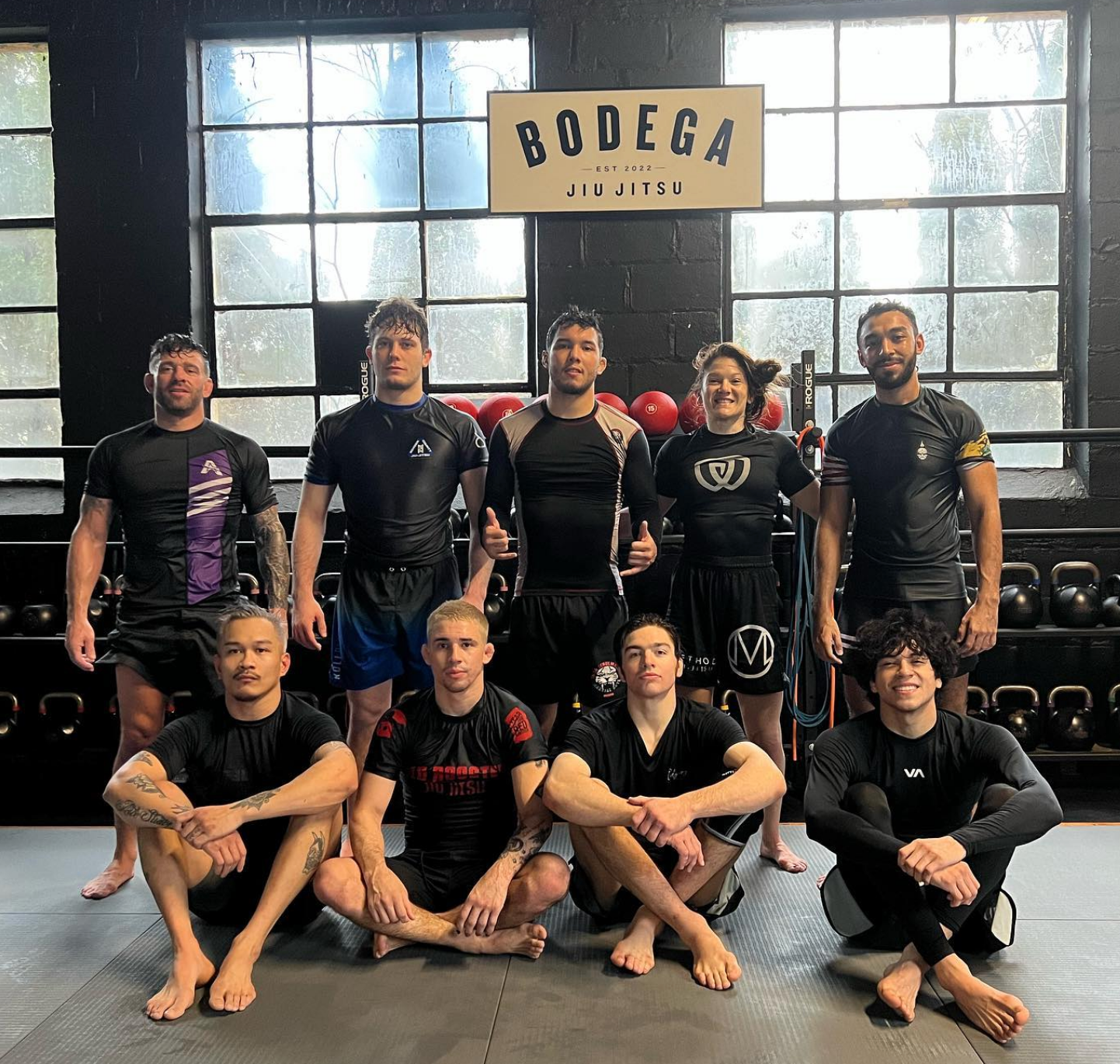
When you are ready, you can experience that approach directly at Bodega Jiu-Jitsu. We keep the focus on safe fundamentals, steady improvement, and a community that makes showing up feel worth it, even on busy weeks.
Refine technique, timing, and control at Bodega Jiu-Jitsu.