Jiu-Jitsu is one of the rare workouts that trains your body and your attention at the same time.
If you live in Maplewood, chances are your calendar is already full: work, commuting, family obligations, community events, and the little stuff that somehow eats a whole evening. When you think about starting Jiu-Jitsu, the first question usually is not Can I do this? It is How would I fit it in and still feel human the next day?
We built our adult program around that exact reality. Our goal is to make training approachable for busy adults who want practical skill, real fitness, and a clearer head, without needing to overhaul your entire lifestyle. Jiu-Jitsu is technique-first and leverage-based, which means you can make meaningful progress even if you are not starting as a lifelong athlete.
Just as important, training gives you a place to focus on one thing. Phones stay off the mat, your to-do list gets quieter, and you get to practice being present. That might sound small, but over time it adds up to better energy, better posture, and a stronger sense of balance in your week.
Why Jiu-Jitsu Works So Well for Busy Adults in Maplewood
Busy adults do not need more chaos. You need training that is structured, repeatable, and worth the time you carve out for it. Our approach is built around a few fundamentals that make Jiu-Jitsu a practical fit for adult life.
First, it is skill-based conditioning. You are not just doing exercise for exercise’s sake. You are learning positions, escapes, controls, and finishes that create a clear sense of progress. Second, it is scalable. You can train with intention and control, adjusting intensity based on how you slept, what your knees feel like, or how long you sat at a desk that day.
Finally, the training environment matters. We emphasize cooperation and respect because that is how adults actually improve consistently. You get challenged, but you also get guided. You learn how to move safely with a partner, how to breathe under pressure, and how to keep going when something feels unfamiliar.
Focus: The Skill Nobody Talks About Enough
When people say they want “focus,” they often mean they want their brain to stop sprinting in ten directions. Jiu-Jitsu helps because it forces your attention into the present moment. You are tracking grips, weight shifts, distance, timing, and posture, and if your mind drifts, you feel it immediately.
We teach you to solve problems in real time. If someone passes your guard, you learn to frame, recover, and rebuild position. If you get pinned, you learn how to stay calm, create space, and escape step by step. That process builds a kind of practical focus that carries over to work, parenting, and stressful conversations.
A nice side effect is that many students report better stress management after training. We cannot promise that your inbox will magically shrink, but we can tell you that learning to breathe and think under pressure changes how pressure feels in daily life.
Strength Without “Gym Brain”: How Adults Get Stronger Here
A lot of adults want strength, but not everyone wants to live in the weight room. Jiu-Jitsu develops strength through movement patterns that involve your whole body, especially your hips, back, and core. You learn to connect your limbs to your base, so effort becomes efficient instead of frantic.
Our classes naturally build:
• Core strength that supports posture, especially if you sit for work
• Grip and pulling strength from hand fighting and control positions
• Hip strength and mobility from guard work, bridging, and technical stand-ups
• Shoulder and upper-back endurance from framing, posting, and maintaining structure
• Leg drive from top pressure and stable base positions
Because technique matters so much, you also learn when to relax. That is a real form of strength: knowing when you can conserve energy and when you need to apply it. For busy adults, that efficiency is everything.
Balance and Coordination: What You Feel After a Few Weeks
Balance is not just standing on one foot. It is knowing where your weight is, how to shift it, and how to keep your structure when someone is trying to move you. Jiu-Jitsu trains that in a very honest way. If your base is too narrow, you get tipped. If your posture collapses, you get pulled. The feedback is immediate.
We spend time on stance, movement, and how to connect your feet to your hips. Over time, most adults notice they move better in everyday life: picking up kids, carrying groceries, stepping off a curb in winter, or just feeling steadier after a long day.
Balance also includes emotional balance. When you practice staying composed in uncomfortable positions, you build a quieter kind of confidence. You are not guessing anymore. You have tools.
What to Expect in Your First Adult Class
Walking into your first class can feel like a lot, especially if you have not done a martial art before. We keep the experience simple and structured so you can focus on learning.
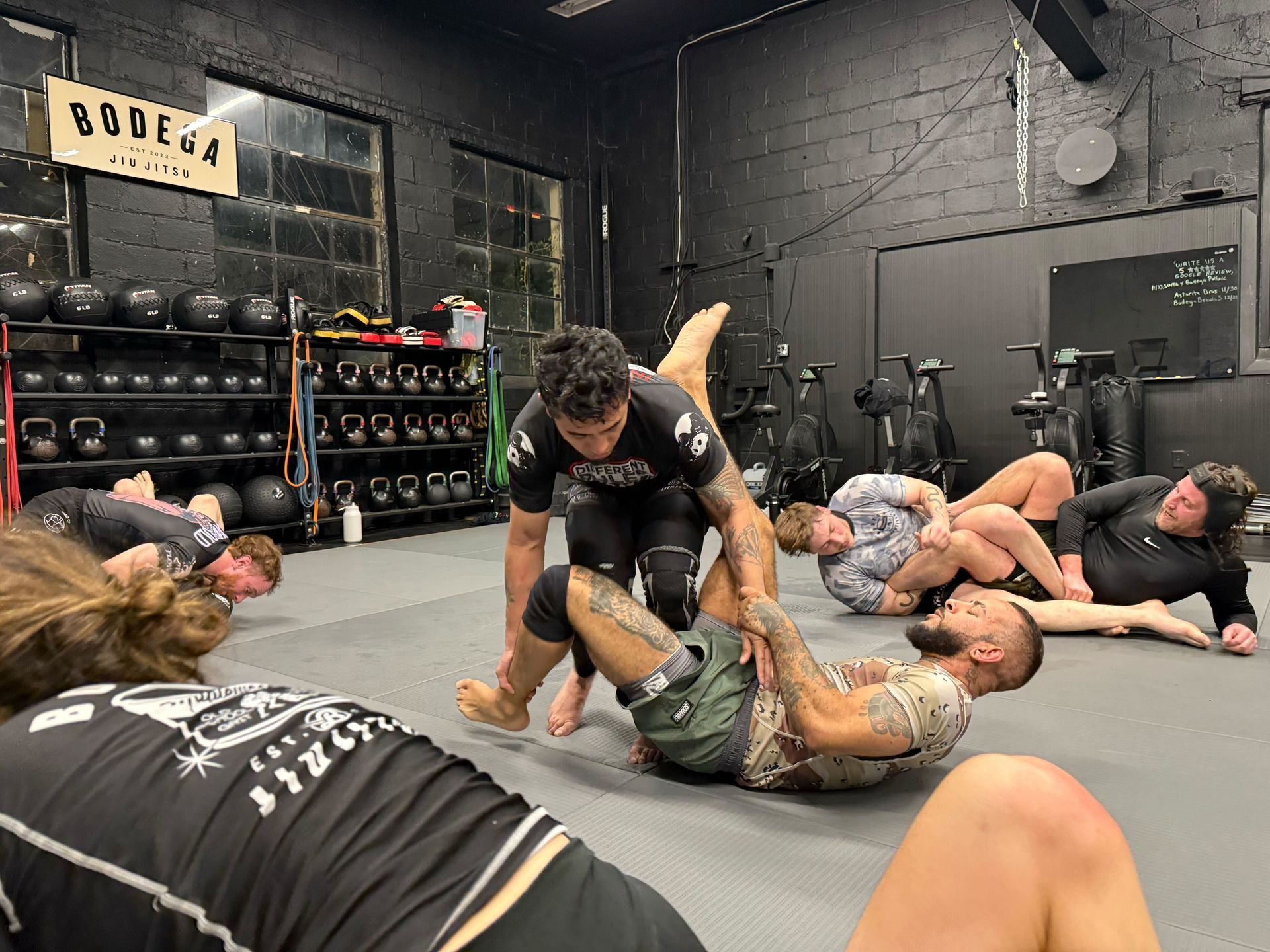
A typical beginner-friendly class includes a warm-up that prepares your joints and gets you moving, technique instruction with clear details, and partner drills where you repeat the movement enough times to understand it. If live training is included, we keep it controlled and appropriate for your experience level. You can always ask questions, and we would rather you slow down and learn clean movement than rush through reps.
You do not need to be “in shape” first. Training is how you get in shape. The only real requirement is a willingness to start, and a willingness to be a beginner for a little while.
No-Gi Training and Striking: Choosing the Right Fit
Our core offerings emphasize no-gi Jiu-Jitsu and striking. No-gi focuses on control without the traditional uniform grips, which means you learn to manage distance, positioning, and pressure using body mechanics. Many busy adults like no-gi because it feels straightforward and athletic, and it translates well to practical movement.
Striking adds another layer of skill and conditioning. It improves timing, coordination, and cardio, and it can make you feel more comfortable in your own space. For some adults, striking is the perfect complement to grappling because it balances intensity with precision.
If you are not sure where to start, that is normal. We can help you pick a path based on your goals: fitness, self-defense, stress relief, or simply learning something challenging that keeps you engaged.
A Beginner Roadmap That Fits Real Life
Consistency beats intensity, especially for adults with jobs and responsibilities. You do not need to train every day to improve. You need a plan you can actually repeat.
Here is a simple roadmap we recommend for many beginners:
1. Start with 2 classes per week for the first month to build familiarity and reduce soreness spikes
2. Focus on survival basics first: posture, frames, escapes, and safe movement patterns
3. Track one small win per class, like a clean technical stand-up or a successful guard recovery
4. Add a third class only when your recovery feels steady, not when motivation spikes
5. Revisit fundamentals regularly, because fundamentals are what work when you are tired
This approach keeps progress realistic. It also helps you avoid the common trap of doing too much too soon, then disappearing for a month because everything hurts.
Recovery for Busy Professionals: The Unsexy Secret
Recovery is where most adult training plans succeed or fail. You can love Jiu-Jitsu and still burn out if you treat your body like it is 22 again. We coach recovery in practical ways: warm-ups that protect your joints, controlled training intensity, and an emphasis on technique over ego.
A few habits make a big difference:
Sleep matters more than supplements. Hydration helps your joints feel better. Light movement on off days, like walking, keeps you loose. And if you are sore, you can still train, but we adjust your pace and focus. Some days you sharpen details instead of chasing hard rounds. That is not “taking it easy,” it is training smart.
Self-Defense Confidence Through Control and Leverage
Jiu-Jitsu has a reputation for practicality because it teaches you how to manage distance, control positions, and create options under pressure. We emphasize leverage and positioning so you can use technique rather than relying on strength alone.
You learn how to stay safer by:
• Understanding how to stand up and create space when you need it
• Learning control positions that reduce chaos and protect you from strikes
• Practicing escapes so you do not freeze in bad positions
• Building awareness of balance, posture, and distance in close-range situations
We keep the training respectful and cooperative, but we also keep it real enough to be useful. Confidence comes from repetition and clarity, not from hype.
Training as a Family Ecosystem: Youth Grappling in Maplewood
A lot of Maplewood parents want a training routine that does not pull the family in opposite directions all week. That is why we also support Youth Grappling in Maplewood as part of a broader training culture where kids learn movement, discipline, and composure in an age-appropriate way.
When adults train and kids train, something cool happens at home. The vocabulary becomes shared: posture, balance, breathing, patience. Families start talking about effort and progress in a healthier way, because everyone understands what it feels like to learn a hard skill. And frankly, it is easier to stay consistent when training becomes part of the family rhythm.
Grappling Arts Maplewood: Skills That Show Up Outside the Gym
People often search for Grappling Arts Maplewood because they want something more than a workout. They want competence. They want a skill set that makes them feel capable in their own body.
That is what grappling gives you: problem-solving under pressure, physical literacy, and the ability to stay calm while working hard. Even if you never compete, the skill development is real. You learn to set small goals, collect reps, and improve through honest feedback. Over time, that practice changes how you carry yourself.
And yes, you will get tired. You will also get better at recovering, better at pacing yourself, and better at showing up even on days when motivation is low. That is a busy adult superpower.
Take the Next Step
Building focus, strength, and balance is not about grinding yourself down. It is about training with intention, learning leverage, and showing up consistently enough to let the skills compound. That is the heart of our program, and it is why adults who start Jiu-Jitsu often stick with it longer than they expect.
If you are ready to train in Maplewood with a structure that respects your schedule, we would love to help you get started. At Bodega Jiu-Jitsu, we keep the path clear: learn the fundamentals, train safely, and build a practice you can sustain.
Train with purpose and see real progress by joining a grappling program at Bodega Jiu Jitsu.