Jiu-Jitsu is one of the most practical ways to build real-world confidence while getting a workout that actually keeps your mind engaged.
If you have ever searched for adult Jiu-Jitsu in Maplewood, NJ, you have probably noticed the same pattern: people want something that feels useful, not just exhausting. We get it. Most adults are juggling work, commuting, family, and the general noise of life, so your training time has to matter.
That is why we teach Jiu-Jitsu as a skill you can feel right away: better balance, smarter movement, and calmer decision-making under pressure. You do not need an athletic background, and you do not need to “get in shape first.” You show up, we guide you, and you build from there.
What Jiu-Jitsu Really Is (and Why Adults Stick With It)
Jiu-Jitsu is grappling: controlling distance, posture, and leverage so you can escape bad positions, reverse them, and finish with submissions when appropriate. What makes it different from a typical fitness class is that the problem changes every round. Your partner is not a machine, and you are not just repeating reps, so your brain stays switched on.
Adults often stick with training because progress shows up in a lot of places at once. Your cardio improves, sure, but so does your coordination, your patience, and your ability to stay composed when things get uncomfortable. That “pressure” is controlled, coached, and scaled to your level, which is a big reason Jiu-Jitsu becomes a long-term habit instead of a two-week phase.
We also train in a way that respects real schedules. If you can make it in consistently, even twice a week, the compounding effect is real: techniques connect, timing sharpens, and you start to feel at home on the mats.
Benefits Backed by Research (Confidence, Mood, and Community)
The most meaningful benefits are not always the ones you expect. A recent adult BJJ study reported high self-reported improvements across confidence, anxiety reduction, mood, community, and concentration. In that study, 87.6 percent of adult participants said BJJ improved confidence, and 87.5 percent said it reduced anxiety. Mood improvements were reported by 96.9 percent, and a sense of community was reported by 100 percent of participants.
Those numbers track with what we see in class every week. People walk in carrying stress and second-guessing, and over time you can literally watch posture change. Not perfect days, not constant motivation, just steadier energy and a stronger baseline.
Of course, Jiu-Jitsu is not a medical treatment, and we never position it that way. But as a practice, it gives you structure, movement, and a place to focus on something concrete. For a lot of Maplewood adults, that is exactly what is missing.
Who Our Adult Grappling Classes Are For
We teach Adult Grappling in Maplewood for real people, not just lifelong athletes. If any of these sound familiar, you are in the right place:
• Beginners who want a clear path and coaching that explains the “why,” not just the move
• Busy professionals who need a challenging workout that fits a weeknight routine
• Adults returning to exercise who want something skill-based instead of mindless cardio
• People who want practical self-defense skills without living in fear or hype
• Women and men who want a training space where control, respect, and safety are non-negotiable
You can train for fitness, self-defense, competition, or just because you like learning hard things. We are here for all of it, and we keep the room welcoming while still taking the training seriously.
What to Expect in Your First Class
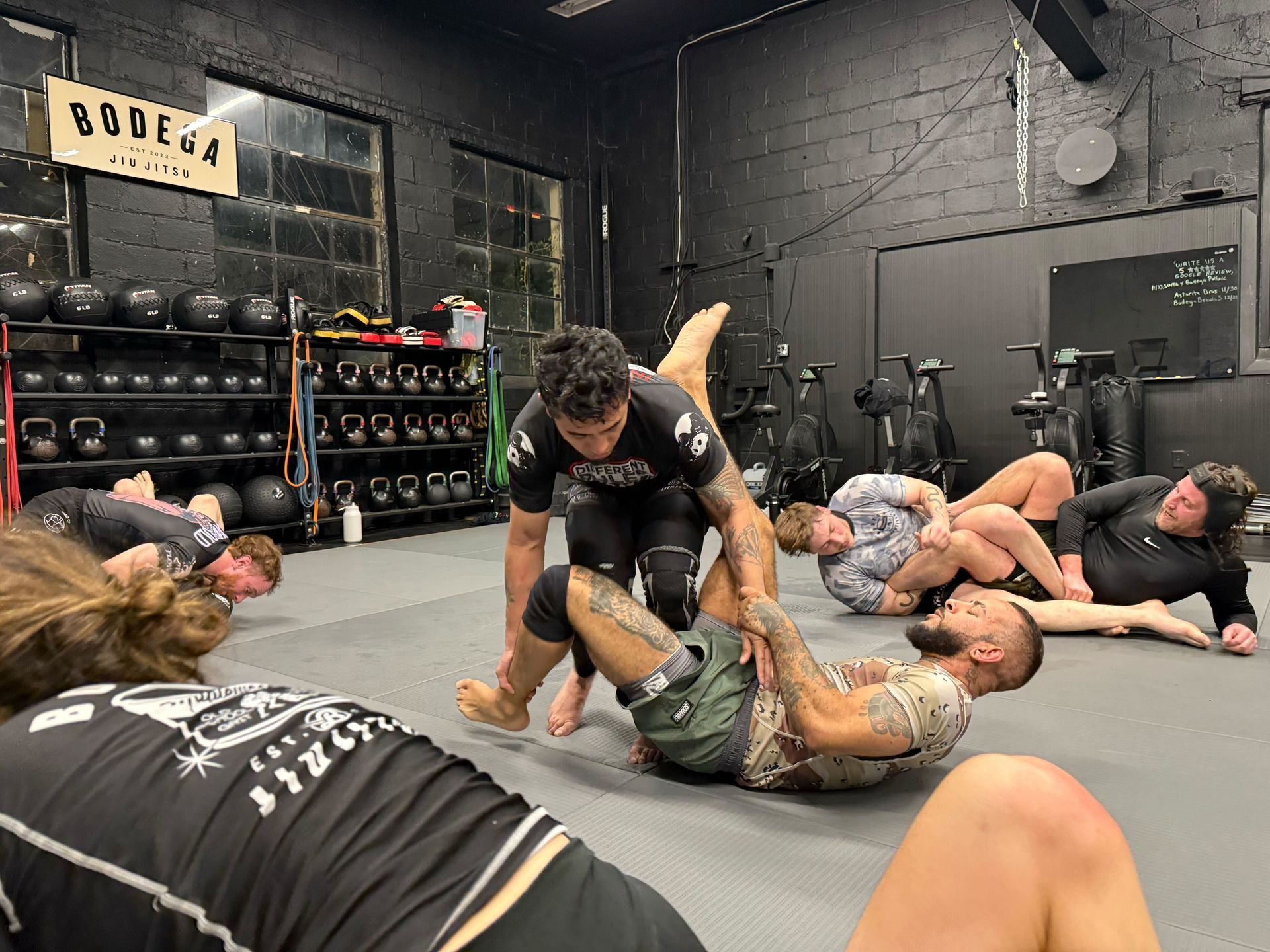
Your first session should feel structured, not chaotic. We start with a warmup that builds movement patterns used in grappling: hip escapes, bridging, technical stand-ups, and basic mobility that helps you move safely on the ground.
From there, we teach a small set of techniques with a clear goal, like escaping a pin, maintaining top control, or finishing a simple submission with good mechanics. You will drill with a partner, and we will help you adjust details that make the technique work without muscling through it.
Then, depending on the class format and your comfort level, you may do controlled live rounds. This is where Jiu-Jitsu clicks, but it should never feel like you got thrown into the deep end. We emphasize tapping early, protecting your training partners, and learning at a pace you can repeat next week.
A few things we want you to remember right away:
- You can always ask questions, even if you think it is “basic”
- You can always take a round off
- You do not need to win anything in your first month, or ever
Gi vs No-Gi: What Is the Difference?
A common question is whether you should start in the gi or in no-gi. In gi training, you wear a traditional uniform and grips on the fabric become part of the game. In no-gi, you wear athletic training gear, and grips are based on body control, positioning, and hand fighting rather than sleeves and collars.
Our focus is world-class no-gi Brazilian jiu-jitsu in Maplewood, so if you are drawn to a modern style of grappling, you are going to feel at home. No-gi tends to be faster, with more emphasis on movement, wrestling-style entries, and controlling limbs without relying on cloth grips.
That said, the core skill is still Jiu-Jitsu: balance, leverage, timing, and decision-making. Once you understand the fundamentals, your game becomes adaptable.
Why No-Gi Grappling Is Growing (and What That Means for You)
No-gi grappling keeps gaining momentum, and it is not just a trend. Competition formats like ADCC and submission-only events have helped push no-gi into the spotlight, and the training culture has evolved right along with it.
Modern grappling also borrows heavily from wrestling in the best way. Standing exchanges, takedown entries, and clinch work are now part of what many adults want, because it rounds out your skill set and makes training feel complete. Even if you never plan to compete, learning how to manage the stand-up phase builds confidence fast.
Leg locks are another major shift. Heel-hook systems and leg entanglements are mainstream at advanced levels now, which means responsible coaching matters. We treat these positions with the respect they deserve, introducing concepts progressively and emphasizing control and partner safety.
And yes, recovery has entered the conversation too. More athletes are using wearables and apps to track sleep, heart rate, and overall training load. You do not need gadgets to train well, but you do need to recover well. Paying attention to rest, hydration, and stress is part of sustainable Jiu-Jitsu, especially for adults.
Safety, Control, and Training Smart as an Adult
If you are worried about injuries, you are not alone. Grappling is contact-heavy, and we take safety seriously because training only works if you can keep showing up.
We coach three layers of safety every class: good mechanics, clear communication, and controlled intensity. You will learn how to tap, how to apply submissions with control, and how to train with partners of different sizes and experience levels without turning it into a fight.
If you are older, coming back from a long break, or managing old aches, we can scale the pace. There is a big difference between “hard training” and “reckless training,” and we are committed to the first one.
A simple rule that keeps people on the mats for years: train today so you can train tomorrow. That mindset builds skill faster than going all-out for two weeks and disappearing for two months.
How Long Does It Take to Feel Comfortable?
Comfort is a funny word in Jiu-Jitsu, because the whole point is learning to operate while things are uncomfortable. But the kind of comfort you probably mean is: knowing what is happening, feeling safe, and not feeling lost every minute.
Most adults start to feel oriented within the first few weeks if they train consistently. You will recognize positions, understand basic goals, and feel the rhythm of drilling versus live rounds. By a few months, you are usually making real choices instead of just reacting.
Progress is not linear. You will have days where everything clicks, and days where you feel like a beginner again. That is normal. The difference is that you are building a skill, not just burning calories, so every repetition counts even when it feels messy.
How Often Should You Train Each Week?
For most adults, consistency beats intensity. We usually recommend starting with two classes per week. That is enough frequency to retain what you learned, build conditioning, and keep the habit alive without wrecking your schedule.
If you want faster progress, three days a week can be a great next step once your body adapts. More than that is possible too, but only if your recovery, sleep, and stress levels support it. We would rather see you train twice a week for a year than six times a week for a month.
Your training plan should fit your actual life in Maplewood, not an imaginary version of your life where nothing ever runs late.
What to Wear and What to Bring
No-gi typically means a rash guard and grappling shorts, or athletic shorts without pockets or zippers. If you are not sure what you have is right, ask us and we will help you sort it out.
For your first class, keep it simple:
- Water bottle you can keep nearby
- Sandals or flip-flops for walking off the mats
- A small towel if you like having one
- A clean set of training clothes that you can move in
You do not need a pile of gear to start Jiu-Jitsu. You need consistency and a willingness to learn, even when you feel awkward at first.
Jiu-Jitsu as a Maplewood Wellness Habit
We love that Maplewood has a strong wellness culture, but we also know adults here want something practical. Jiu-Jitsu fits because it blends functional strength, cardio, coordination, flexibility, and self-discipline into one practice. It is not just “workout time.” It is skill time.
It also becomes a community anchor. You see familiar faces, you share small wins, and you get a break from screens and stress. That matters more than people expect. Training partners become the reason you show up on the days you would rather skip.
If you commute, if you sit a lot for work, if you carry tension in your shoulders and hips, grappling can feel like a reset. Not always comfortable, but honest. You move, you breathe, you problem-solve, and you leave lighter.
Take the Next Step
If you are looking for Adult Grappling in Maplewood that balances modern technique, safety, and a genuinely supportive training room, we built our programs to meet you where you are. You can start as a complete beginner, learn at a sustainable pace, and develop Jiu-Jitsu that holds up under pressure without turning training into chaos.
When you are ready, Bodega Jiu-Jitsu is here in Maplewood with a clear class structure, a no-gi focus, and coaching that treats your time like it matters. The next step is simple: pick a day, show up, and let us help you build skills, confidence, and balance on the mats.
Become part of a positive, growth-focused grappling community at Bodega Jiu Jitsu.