


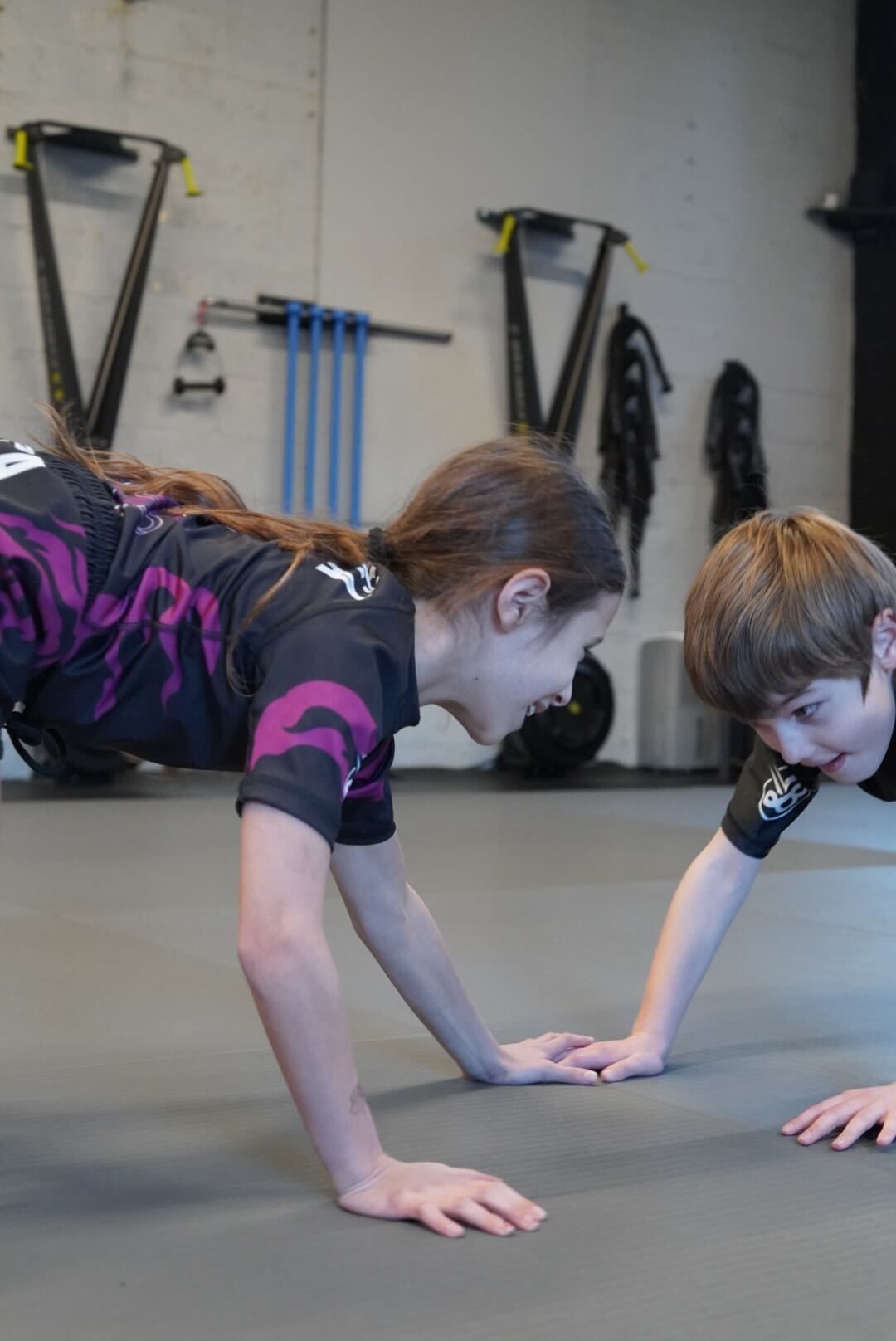
Youth Jiu-Jitsu turns “use your words” into a real skill your child practices, week after week, with coaches and partners.
Kids do not improve communication because we tell them to. They improve because they get repeated, real-life chances to listen, speak up, clarify, and cooperate in situations that feel meaningful. That is one of the underrated strengths of Youth Jiu-Jitsu: the training is physical, but the learning is social the whole time.
In our Youth Jiu-Jitsu in Maplewood, we see communication show up in small moments that add up. A child checks in with a partner before a drill. Another raises a hand because an instruction did not click. Someone else takes a breath instead of blurting out frustration when a technique goes sideways. None of that is “magic,” and we never assume the same outcome for every kid, but the opportunities are built into the structure of class.
If you are a Maplewood parent looking for an activity that supports confidence and connection without relying on a loud sideline or a scoreboard, Youth Jiu-Jitsu can be a strong fit. It is partner-based, coached closely, and full of practical routines that help kids learn how to communicate clearly and respectfully.
What “communication” looks like in Youth Jiu-Jitsu class
When people hear “jiu-jitsu,” communication is not the first thing that comes to mind. But if you watch a kids’ class closely, you will notice how often students have to exchange information to train safely and successfully. Grappling is cooperative by design: one child cannot practice without another child participating.
We build communication into partner work in simple, direct ways. Before drills begin, we encourage kids to check readiness and comfort. During practice, we want them to keep talking in short, useful phrases instead of staying silent and guessing.
Here are a few examples of the kind of language we coach and model on the mat:
• “Are you ready?”
• “Can we go slower?”
• “Can you show me that again?”
• “That hurts, can we adjust?”
• “I need a break.”
• “Good job, thanks for helping.”
That may sound basic, but it is exactly the point. Kids do not need perfect speeches. They need repeatable, low-pressure scripts that work in the moment, especially when emotions are running a little hot or their body is tired.
Why Youth Jiu-Jitsu creates more talking than you might expect
A lot of kids’ activities are either fully verbal (like classroom discussion) or mostly nonverbal (like individual sports drills). Youth Jiu-Jitsu sits in a sweet spot: kids have to communicate with words, and they have to back those words up with calm behavior, self-control, and respect for boundaries.
Because we rotate partners, students learn to communicate with different personalities and sizes. That matters. Your child might train with a quiet partner one round and an energetic partner the next. Each round becomes practice in reading the room, setting expectations, and staying polite even when things feel awkward at first.
We also treat safety communication as a core skill, not a side note. A high-quality kids’ class should constantly reinforce the idea that stopping, tapping, and asking to reset are responsible choices. When children feel permitted to speak up, they usually start using that skill in other settings, too, although we always describe that as a possibility, not a guarantee.
Five communication skills kids practice through Youth Jiu-Jitsu
1. Listening and following multi-step directions
Listening is not passive in jiu-jitsu. It is a performance skill. A child has to watch a demonstration, remember the steps, and then try it with a partner in real time. That process strengthens attention and teaches kids how to track details without getting overwhelmed.
We keep instructions clear and age-appropriate, then we repeat key points as kids move. That matters because children learn differently: some need to see it, some need to hear it twice, and some need to try it once before it makes sense. On the mat, we normalize that learning curve. If your child needs a reminder, we want them to ask for one.
Over time, Youth Jiu-Jitsu training can help a child get more comfortable hearing feedback and making corrections without taking it personally. In school, that often looks like raising a hand to clarify instead of shutting down. Again, it depends on the child and consistency, but the practice environment supports that kind of growth.
2. Asking questions and requesting help (without embarrassment)
Many kids stay quiet because they do not want to be wrong in front of others. We work to make questions feel normal. If a student says, “I forgot step two,” we treat it as useful information, not a problem.
In Youth Jiu-Jitsu in Maplewood, questions are part of the learning rhythm. A child might ask a coach to repeat a grip detail, or ask a partner, “Where does my foot go?” That is healthy communication: it is specific, it is timely, and it is focused on solving the problem.
This is also where partner rotation helps. When kids work with different classmates, they learn how to speak up with someone new. It is a practical skill for Maplewood life in general, from group projects to new classrooms to birthday parties where not everyone already knows each other.
3. Boundary-setting and consent language
One of the most transferable communication lessons in jiu-jitsu is learning to set boundaries clearly. Kids are learning a contact sport, but that does not mean “anything goes.” We teach that respectful training includes checking in, managing pace, and responding immediately when a partner taps or asks to pause.
Boundary communication can look like:
• “Let’s go lighter.”
• “My neck feels uncomfortable there.”
• “Can we reset from the start?”
• “Please stop.”
We want kids to understand that these sentences are allowed, and that using them is part of being a good training partner. This is also why we emphasize hygiene routines and personal space expectations. Small habits like lining up, waiting your turn, and asking before you jump into a drill help kids practice respectful interaction, not just technique.
4. Giving and receiving feedback with peers
Kids do not just receive coaching from us. They also learn how to help a partner. That might mean reminding someone of the next step in a drill or offering a simple cue like, “Keep your elbows in.”
We keep that peer feedback positive and specific. The goal is not to “coach the room” or correct someone harshly. It is to learn how to support a teammate in a way that feels respectful. When kids practice that on the mat, it can translate into more mature communication in everyday situations, like working through a disagreement without escalating.
Research on youth martial arts has reported positive associations with cooperation, empathy, and communication, while also noting that the overall evidence base is still developing and outcomes depend heavily on program quality and context.[1] We agree with that cautious framing. The environment matters. How adults correct behavior matters. The class culture matters.
5. Self-regulation: the quiet skill underneath better communication
A child who can pause before reacting is a child who can communicate more clearly. In jiu-jitsu, kids meet frustration in a controlled setting: a technique feels tricky, a partner is stronger, or a game does not go their way. We treat those moments as training opportunities.
We coach kids to reset: breathe, listen, and try again. That “reset” habit supports communication because it creates space between feeling and reacting. Instead of yelling, a child can say, “I need help,” or “Can we slow down?” That is a big deal, even if it sounds small.
There is also emerging supportive evidence from parent-reported outcomes. A 2025 study based on parent reports found high perceived benefits from Brazilian jiu-jitsu, including confidence, commitment, mental flexibility, concentration, and community belonging.[2] Because those findings reflect perceptions rather than a controlled cause-and-effect trial, we treat it as encouraging context, not proof.
Why Youth Jiu-Jitsu in Maplewood works well for many families
Maplewood families are often balancing school, after-school activities, and work schedules, and it helps when a youth program is close to home and predictable. Our kids’ classes follow consistent routines, so children know what to expect: warm-up, instruction, drilling, and games or controlled sparring based on age and experience.
Youth Jiu-Jitsu in Maplewood can also be a good match for kids who do not love traditional team sports. There is still teamwork, but it is built through partner rotation, shared rules, and cooperative problem-solving rather than big groups shouting plays. For some kids, that feels calmer and more approachable.
We also see how quickly kids learn names and basic introductions when partner changes are normal. A child does not need to “break into” a friend group. They get a structured reason to interact, over and over, in a supervised setting where we are actively teaching the social rules.
What to look for in a communication-friendly kids’ program
If your goal includes communication, pay attention to what the class rewards. A good Youth Jiu-Jitsu environment should reward safe behavior, respectful speech, and consistent effort, not just “winning” exchanges.
In our program, we focus on relationship-centered coaching practices that support communication and social-emotional learning, including:
• Clear demonstrations paired with simple, repeatable cues kids can remember
• Positive correction that preserves dignity, especially when a child is frustrated
• Consent and boundary reminders, including stopping immediately when a partner taps
• Partner rotation so kids practice cooperation with many classmates
• Age-appropriate drills and games that keep energy focused without turning chaotic
• Predictable routines that reduce anxiety around transitions
• Moments for kids to lead, like showing a warm-up movement or answering a review question
Research on martial-arts interventions suggests potential benefits for social interaction and behavior in certain groups when programs are inclusive and carefully supervised, but results vary and each child’s needs are individual.[3] We encourage families to treat martial arts as one helpful tool, not a replacement for speech-language therapy, counseling, or specialized developmental support.
Parent checklist: questions that make communication outcomes more likely
Before your child joins, it helps to know how the class handles the everyday moments that shape culture. Here are questions you can ask us, and questions you should feel comfortable asking on the first day:
1. How do you teach kids to communicate discomfort or ask to slow down during drills?
2. What is your process for partner assignments and partner rotation, especially for shy kids?
3. How do you handle tears, frustration, or conflict between students in the moment?
4. What safety rules are reinforced every class around tapping, pausing, and respectful contact?
5. Can parents observe, and what should we watch for to see whether our child feels supported?
6. How do you accommodate attention, sensory sensitivities, or anxiety while still keeping structure?
If your child has ADHD, autism, anxiety, or sensory sensitivities, we recommend a quick conversation before the first class so we can talk through class flow, physical-contact expectations, and any helpful accommodations. Some kids thrive with the routine and the clear rules, and some need a slower introduction. Either way, we want you to feel informed.
Take the Next Step
If you want an activity that builds fitness while also giving your child repeated practice with listening, speaking up, and cooperating, Youth Jiu-Jitsu is a practical place to start. The best part is that these communication moments are not separate from training, they are built into drills, partner work, and the way we coach behavior on the mat.
At Bodega Jiu-Jitsu, we keep our Youth Jiu-Jitsu in Maplewood classes structured, supervised, and age-appropriate, so kids can learn to train safely while practicing the kind of clear, respectful communication you want to see outside the academy, too.
Continue your Jiu-Jitsu journey beyond this article by joining a class at Bodega Jiu-Jitsu.