
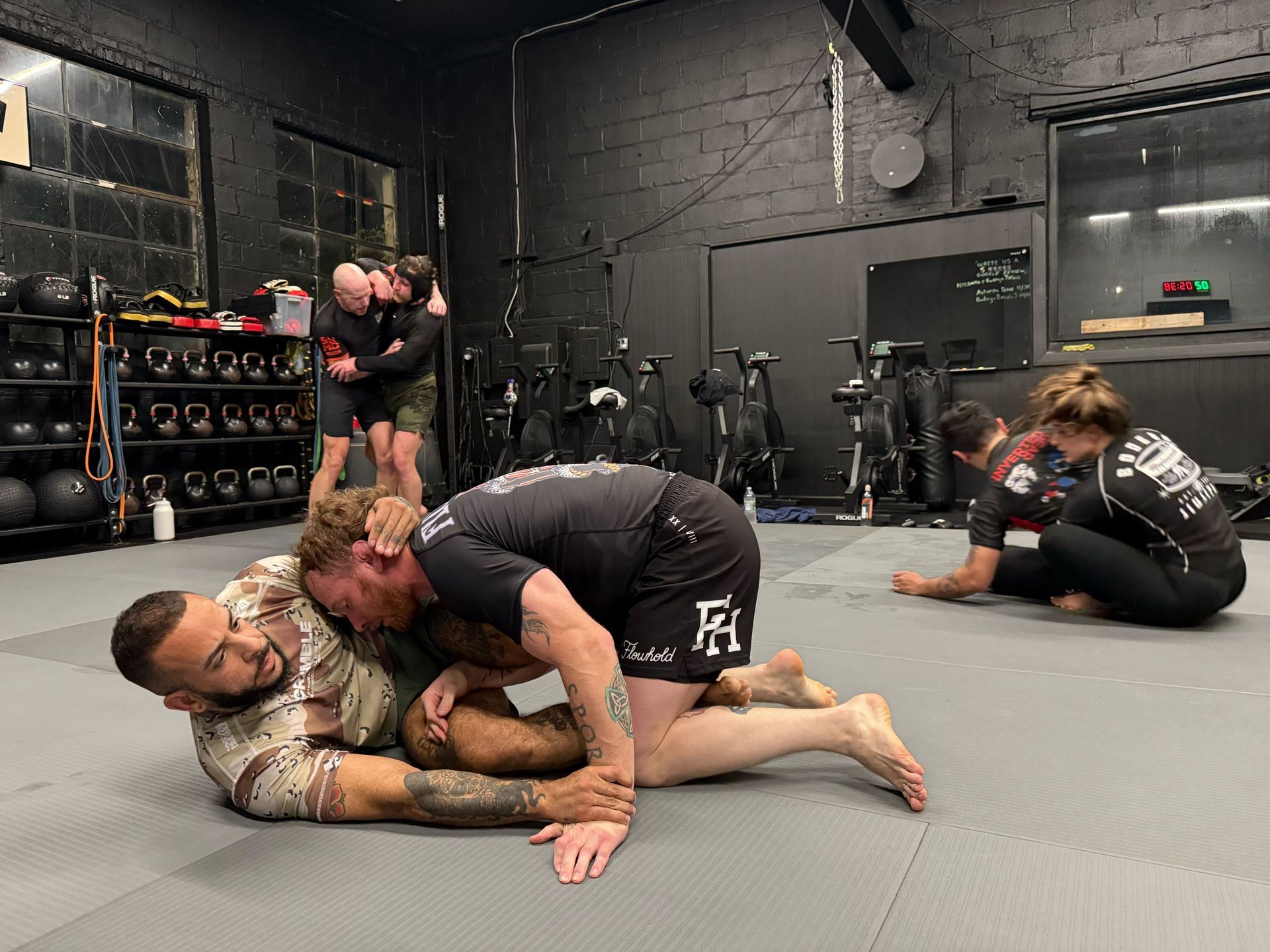
Grappling turns “getting in shape” into a skill you build, week by week, with your whole body involved.
If you have ever tried to “just work out more,” you already know the problem: motivation fades when the routine feels repetitive. Grappling changes that because your fitness comes from learning, moving, and solving real problems with a partner, not counting reps in silence. In Maplewood, that difference matters, especially when your schedule is busy and you want your training time to actually do something.
We see it all the time in our adult grappling classes: people come in for fitness, and they stay because the work feels purposeful. Grappling is demanding in the best way. It blends strength training, cardio, mobility, coordination, and mental focus into a single session, and you can scale it to your current ability without needing to be “in shape first.”
Even better, the benefits are not just physical. Research on Brazilian Jiu-Jitsu style training shows major mental health gains, including lower anxiety and improved mood for the vast majority of practitioners. When your workouts double as stress relief and confidence building, consistency gets a lot easier to maintain.
Why grappling is a different kind of workout
A typical gym workout isolates pieces: legs on one day, back on another, cardio on a machine if you have time. Grappling is integrated. You move your whole body together, under changing conditions, while staying calm and making decisions. That combination is why it can transform fitness faster than you might expect.
Physically, grappling drives a high physiological demand that supports cardiovascular health, muscular strength, endurance, and improvements in body composition. You get bursts of high output, controlled effort, and active recovery, all inside one class. Over time, your body adapts in a balanced way: stronger hips and legs, more stable shoulders, and a core that works the way it is supposed to work, not just the way crunches pretend it does.
And because grappling involves live partners, your intensity tends to rise naturally. You are not competing against a treadmill setting. You are working with real feedback, and that makes the training honest while still being safe and structured in our program.
The fitness benefits you can feel in everyday life
The most convincing “results” are the moments outside the gym: carrying groceries without thinking about it, walking upstairs without getting winded, standing taller at your desk, sleeping more deeply. Grappling builds those outcomes because it trains movement, not just muscles.
Here are some common changes we hear about after a few consistent months:
• Better cardio without endless running because rounds naturally push your heart rate up and down
• Stronger full-body control through pulling, framing, bridging, and standing up under pressure
• Increased endurance in your legs, grip, and core from continuous positional work
• Improved flexibility and joint resilience from controlled ranges of motion and warmups that make sense
• A noticeable shift in body composition when you train regularly and recover well
Science lines up with the lived experience. Training places demands on both aerobic and anaerobic systems, and advanced athletes show high anaerobic capacity, which helps in intense scenarios. You do not need to be advanced to benefit, but it shows what the activity can build over time.
Grappling as cardio you do not dread
A lot of people in Maplewood want “more cardio,” but not the kind that makes you stare at a wall for 30 minutes. Grappling cardio is sneaky. You are busy learning grips, adjusting angles, escaping pins, and staying balanced. Your heart rate climbs, but your attention is on the task.
This matters for consistency. When your brain is engaged, you are more likely to show up. And when you show up, you improve. That feedback loop is the real secret.
We also structure classes so you are not thrown into the deep end. You will build intensity progressively, with technique first and controlled sparring when you are ready. That approach is one reason adult grappling classes can work for beginners, even if your “current fitness level” feels like a sensitive topic.
Strength and muscle endurance without a bodybuilding plan
Grappling is not about looking strong. It is about being strong in awkward positions. You will build strength through leverage, pressure, and repeated effort: holding posture, staying heavy, controlling distance, and moving your hips when you would rather not.
Because the work is dynamic, you train muscle endurance as much as raw strength. That is a big deal for real-world fitness. In day-to-day life, you rarely need one perfect maximal lift. You need the ability to maintain good mechanics while tired: keeping your back safe, staying balanced, and producing force again and again.
Over 10 to 12 weeks of consistent training, many adults notice measurable changes in how their body performs. Clothes fit differently, stairs feel easier, and your posture looks less “computer-shaped.” Grappling earns those changes, session by session.
The mental side: stress relief, confidence, and resilience
We treat mental fitness as part of the training, not a bonus. Grappling forces you to breathe, slow down, and make decisions while you are uncomfortable. That is basically resilience practice, with a very real feedback system.
Studies back this up. Large majorities of practitioners report reduced anxiety, boosted confidence, improved mood, and stronger self-control and resilience. Benefits also tend to increase with experience, which makes sense: the longer you train, the more you learn that tough moments are temporary, and you can work through them.
In Maplewood, a lot of adults carry stress from commuting, parenting, and constant digital noise. Grappling gives you a place where your attention has to narrow. For an hour, you cannot multitask. You have to be present. That is one reason people leave class looking lighter, even if the workout was intense.
What to expect in your first month of adult grappling classes
Starting something new can feel like a lot, especially when it involves close contact and unfamiliar movements. We make the on-ramp clear and beginner-friendly. You will learn basics first, and you will get plenty of repetition before anything feels fast.
In the first month, our goal is not to “test” you. It is to give you a foundation:
1. Learning how to move safely on the ground, including base, posture, and hip movement
2. Understanding positional goals, like escaping bad spots and holding stable control
3. Practicing a small set of high-percentage techniques you can actually remember
4. Building comfort with partner drills, pacing, and communication
5. Introducing controlled sparring in a way that matches your readiness
This structure is part of why grappling arts Maplewood residents stick with can become a long-term habit. You are not guessing what to do next. You are following a progression that respects your body and your time.
Safety, scaling, and training at the right intensity
A good grappling class is challenging, but it should not feel reckless. We coach you to train with control, tap early, and choose the right pace for your goals. If you want a hard round, we can guide that. If you need a lighter session because work has been brutal or your sleep has been off, that is normal too.
Scaling is simple in practice:
- Technique work lets you focus on mechanics instead of speed
- Partner drills build timing with predictable patterns
- Live rounds can be shortened, slowed down, or limited to specific positions
- Rest is part of training, not a failure of willpower
When you train this way, you can keep showing up. And consistency beats intensity spikes every time, especially for adults who want sustainable fitness.
How often should you train for results in Maplewood?
If you want the most efficient path, two sessions per week is a strong baseline. Research trends in 2023 and 2024 show that training twice weekly is associated with resilience and focus gains for most trainees, and even 1 to 3 sessions weekly can produce noticeable improvements in self-control and mood.
We typically recommend:
- 2x per week for steady progress, balanced recovery, and noticeable cardio and strength gains
- 3x per week if your schedule allows and recovery is solid
- 1x per week if you are starting carefully, with the goal of building the habit first
You do not need to do everything at once. Grappling rewards patience. If you commit to a realistic schedule and keep it for three months, your fitness trajectory can change in a way that feels obvious, not subtle.
Why community matters more than people expect
Fitness is not only physiological. It is social and psychological. When you have training partners who recognize you, notice your progress, and help you learn, it is easier to stay consistent. Grappling has a built-in community structure because you learn with other people, not next to strangers.
We put a lot of care into keeping the room welcoming and focused. You should be able to train hard without feeling judged. You should also be able to ask questions without feeling like you are slowing the class down. That atmosphere is not an accident. It is part of how we help Maplewood adults turn training into a lifestyle, not a short phase.
Grappling for weight loss, mobility, and “feeling athletic” again
Many adults come in saying the same thing in different words: “I want to feel like my body works.” Grappling helps because it rebuilds athletic basics that daily life slowly drains: balance, coordination, reaction time, and confidence in your movement.
For weight loss, grappling can be effective because it combines high calorie burn with muscle-building stimulus. It also tends to reduce stress, which can indirectly support better habits around food and sleep. And unlike a strict plan that depends on willpower alone, the skill-building aspect gives you a reason to keep training even when the scale is stubborn for a week or two.
Mobility improves because you spend time in deep hip positions, rotating through your spine with control, and using your shoulders in stable ranges. It is not random stretching. It is movement with context.
Take the Next Step
If you are ready to make fitness feel engaging again, grappling can be the change that sticks. Our classes in Maplewood are built to give you a clear path: learn the fundamentals, build conditioning through smart intensity, and develop the mental calm that carries into the rest of your week.
When you train with us at Bodega Jiu-Jitsu, you are not signing up for a vague workout. You are joining a program designed around progression, safety, and real results you can feel. If your goal is better cardio, strength, stress relief, or all of the above, we are ready to help you start.
Build confidence and control through grappling at Bodega Jiu-Jitsu.