
Adult Grappling changes your body, but the real surprise is how quickly it changes the way you carry yourself.
Adult Grappling is often described as a workout or a self-defense skill, but in our experience, it lands somewhere deeper than that. You come in for fitness, stress relief, or a new challenge, and you leave noticing that everyday situations feel a little more manageable. Your posture changes. Your breathing changes. Your patience changes too.
What makes grappling different from a typical gym routine is that you are solving problems with another person in real time. That adds pressure, but it also adds progress you can actually feel. And because we build our adult grappling classes around clear fundamentals, you do not need a background in martial arts, a certain body type, or a fearless personality to start.
Below are five surprising ways Adult Grappling can boost both confidence and fitness, especially for busy adults in Maplewood who want something practical, sustainable, and honestly more engaging than repeating the same workout forever.
1. It rewires resilience through controlled pressure
You practice staying calm while your body wants to panic
Most adults are not used to being uncomfortable on purpose. Grappling puts you in safe, supervised positions where you feel pressure, lose balance, get pinned, or get stuck and then learn how to respond. That sounds intense, but it is one of the most confidence-building parts of training.
The mental shift is subtle at first. You start recognizing that discomfort is not the same as danger. In Adult Grappling, you learn to breathe, frame, move, and think even when your nervous system is loud. Over time, that same skill shows up outside the mats in meetings, awkward conversations, and stressful commutes.
Skill-based problem solving builds real confidence, not hype
Confidence sticks when you have receipts. Grappling is technical, and each week you collect small wins: escaping side control, finishing a basic sweep, holding posture, remembering a sequence without freezing. Research on Brazilian Jiu-Jitsu training shows that more experienced practitioners score higher in traits like mental toughness, resilience, self-control, and life satisfaction, with training time correlating to those improvements. That lines up with what we see in class: consistency compounds.
One more interesting data point: practitioners in BJJ report larger confidence gains than participants in more traditional martial arts, with one study noting a 38 percent greater confidence increase. It is not magic. It is the constant feedback loop of try, adjust, improve.
2. It lowers anxiety in a way that feels practical, not fluffy
The stress relief is physical, but also cognitive
A large share of adults report mental health benefits from BJJ style training, including improved mood and reduced anxiety. Survey data has shown 87.5 percent of adults reporting reduced anxiety and 96.9 percent reporting improved mood. We do not treat grappling as therapy, but we do respect what happens when you move your body hard, focus on a task, and finish class feeling like you did something real.
There is a practical reason this helps: during training, your attention narrows. You have to focus on grips, posture, balance, timing, and breath. That concentration pushes your brain out of its usual loop of worries. It is hard to ruminate when you are trying to maintain base.
You train humility, which weirdly helps confidence
This is one of the surprises people do not expect. Adult Grappling can be challenging on the ego, especially in the beginning. You will tap. You will forget steps. You will have days where everything feels clumsy. And then you come back anyway.
That act of returning builds a quieter confidence. You learn that you can be a beginner at something and not fall apart. For professionals and parents in Maplewood juggling a lot, that mindset is valuable. You stop needing perfection to take action.
3. It upgrades functional fitness you can use every day
Grappling develops “real-world strong” movement patterns
If you have ever done a workout that made you sore but did not make life easier, you know the difference between exercise and functional fitness. Adult Grappling asks your body to push, pull, stabilize, rotate, bridge, squat, and scramble, often while carrying another person’s weight or resisting it.
That means the strength you build is not isolated. You develop:
• Core stability that shows up in posture, lifting, and back comfort
• Grip and pulling strength from clinches, grips, and control positions
• Hip mobility and leg drive from bridging, guard work, and stand-ups
• Cardiovascular endurance that builds without mindless cardio sessions
• Coordination and balance that improves because you are always adjusting
Combat sports research in older adults shows improvements in strength, flexibility, agility, balance, and daily activities. Meta-analytic findings include measurable gains in balance scores and functional mobility tests like Timed Up and Go. Translation: this style of training can support you across ages because it is scalable and movement-rich.
It is adaptable, even when you are not “in shape yet”
A common hesitation we hear is, “I need to get in shape first.” We get it, but Adult Grappling is one of the few fitness paths where getting in shape is built into the skill progression. We can scale intensity by adjusting pace, partner matching, starting positions, and how hard you roll.
If you are returning to exercise after a long break, our approach is to keep you moving, learning, and leaving class feeling worked, not wrecked.
4. It builds self-efficacy through small wins that stack fast
You learn to trust your decisions under pressure
Self-efficacy is the belief that you can handle what is in front of you. Grappling is basically a self-efficacy lab. You make choices, see immediate outcomes, and then refine.
At first, you might only remember one escape or one guard pass. That is fine. You use it anyway. Then you add another layer. Over time, your “I don’t know what to do” moments shrink. That is a confidence shift you can feel in your body, not just in your thoughts.
Studies comparing experience levels in BJJ show black belts scoring significantly higher than white belts in mental strength, resilience, grit, and self-control. We are not saying you need to chase a belt to benefit, but the pattern matters: training experience predicts psychological growth.
A simple progression keeps motivation alive
One reason adults quit fitness plans is that progress feels vague. In adult grappling classes, progress is concrete. You either escaped, you did not. You either held posture, or you got folded. It is objective, sometimes humbling, and oddly motivating.
Here is a practical way we suggest tracking progress without overthinking it:
1. Pick one position for the month, like closed guard or side control
2. Learn one escape, one control, and one transition from that position
3. Ask training partners to start there during controlled rounds
4. Notice what fails, then adjust one detail at a time
5. Re-test weekly and log the small improvements
That kind of structure keeps Adult Grappling from feeling random. It turns class into a repeatable practice you can stick with.
5. It gives you community and calm under pressure, not aggression
Controlled sparring teaches composure, not chaos
There is a myth that grappling training makes people aggressive. Our goal is the opposite. We want you to feel more in control, more patient, and more capable of de-escalation because you are not relying on panic.
Rolling is where this happens. You learn how to apply technique with control, tap early, respect partners, and keep your emotions in check. Confidence grows because you know what it feels like to handle real resistance in a supervised environment.
Survey data around BJJ participation often highlights a strong sense of belonging, and we see that too. Adults stick with training when they feel safe, seen, and supported, especially when life is busy and motivation is inconsistent.
Maplewood adults need training that fits real schedules
Most of our students are balancing work, family, and responsibilities that do not pause. Grappling becomes a consistent anchor because it is active, social, and skill-focused. You are not just burning calories, you are learning a craft.
And on days when you show up stressed, you usually leave lighter. Not because the day magically changed, but because you proved to yourself you can do hard things with a clear head. That calm under pressure is a skill, and Adult Grappling trains it directly.
What to expect in our adult grappling classes
If you are curious about grappling arts Maplewood residents can actually stick with, the class experience matters. We keep sessions structured so you can learn, sweat, and improve without feeling lost.
Most classes include:
• A warm-up focused on movement patterns you will use during training
• Technique instruction with clear details and built-in troubleshooting
• Partner drilling to build timing and confidence safely
• Positional rounds so you can practice one situation repeatedly
• Live rolling with guidance on intensity, pacing, and safety
This structure is one reason Adult Grappling works so well for fitness. You get interval-style effort, full-body movement, and a mental challenge all in one session.
Take the Next Step
If you want training that builds real fitness and real confidence at the same time, Adult Grappling is a strong place to start, and we have built our programs to make that start feel doable. The goal is not to “survive” class. The goal is to learn skills that improve your body, sharpen your mind, and give you the calm that carries into the rest of your week.
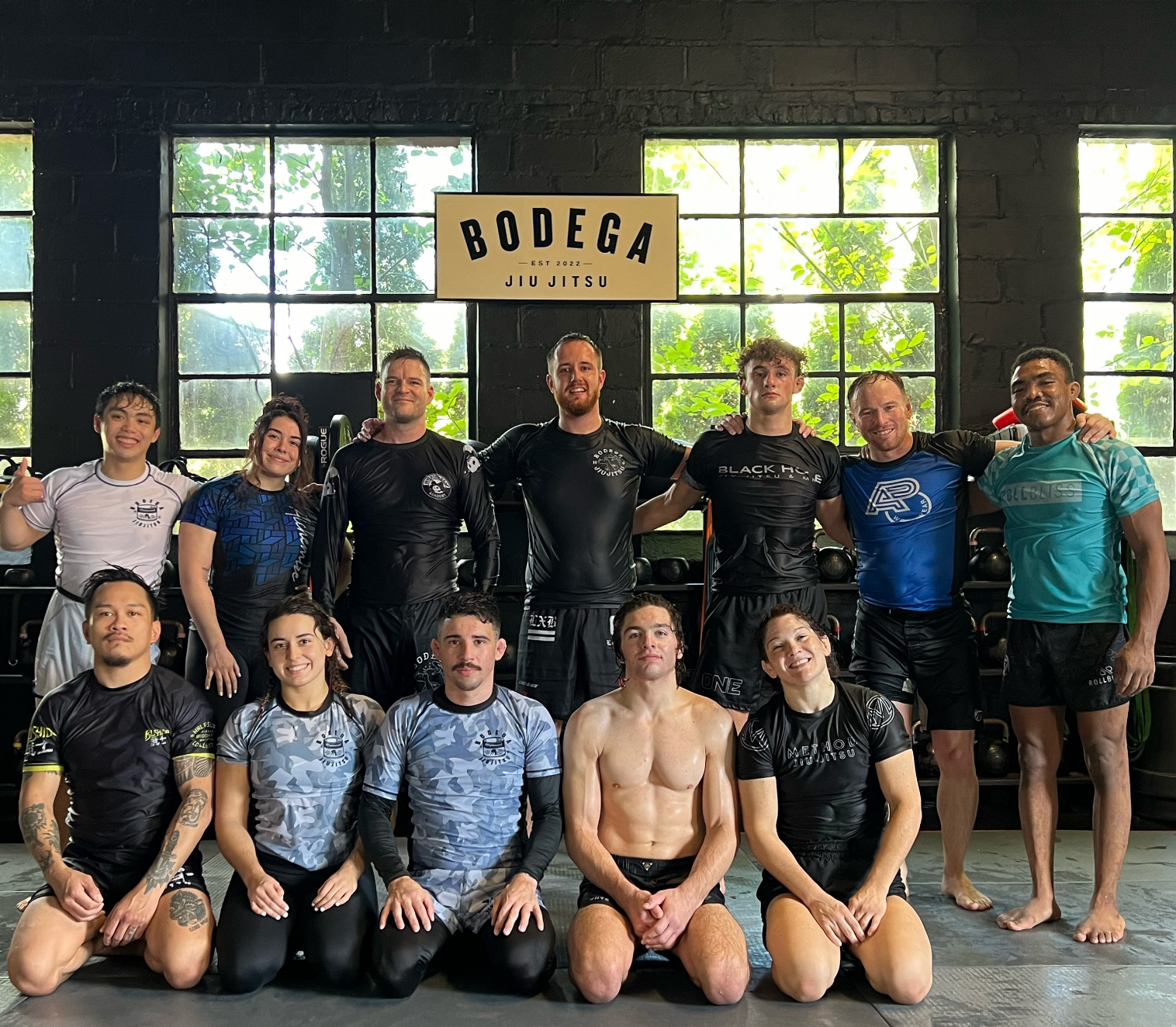
At Bodega Jiu-Jitsu in Maplewood, NJ, we keep our adult grappling classes practical, structured, and welcoming for beginners while still challenging for experienced students. When you are ready, we would love to help you take the first step and keep building from there.
Experience firsthand how Brazilian Jiu-Jitsu can improve your fitness, problem-solving, and confidence by signing up for a free trial class at Bodega Jiu-Jitsu. Bodega Jiu Jitsu