If you want a full-body workout without pounding your joints, grappling is one of the most sustainable ways to get fit and stay consistent.
Adult Grappling is often misunderstood as rough, high-risk training, especially if your only reference point is loud highlight clips. In real beginner training, the opposite is usually true: the goal is control, leverage, and learning how to move well with another person, not crashing into the floor or forcing reps through pain. That technique-first emphasis is a big reason grappling is such a reliable low-impact workout for adults who want results without feeling wrecked.
We built our adult grappling classes for regular people with real schedules. If you sit at a desk, commute, chase kids, or you just feel stiff when you stand up, you are not alone. A smart grappling program can help you build conditioning, strength, and mobility at the same time, while also giving you a skill to work on that keeps training interesting week after week.
In Maplewood, we see a lot of adults who are done with workouts that punish the knees, shoulders, and lower back. Grappling gives you a different path: you can train hard, but you can also train intelligently, scale the intensity, and keep progressing without needing to “win” every round.
Why Adult Grappling counts as low-impact (and why that matters for beginners)
Low-impact does not mean easy. It means you are not repeatedly absorbing hard collisions, heavy landings, or jolting impact through your joints the way you do with running, box jumps, or certain styles of lifting. In Adult Grappling, we spend most of our time in controlled positions where the goal is to move efficiently, balance your weight, and use timing and leverage.
That changes the stress your body experiences. Instead of repetitive pounding, you get steady resistance from a training partner and the mat. You will still work, sometimes a lot, but the load is distributed through posture, frames, and angles rather than impact.
For beginners, this matters because consistency is the whole game. The best program is the one you can do next week, and the week after that. When the workout is low-impact and scalable, you can build a real routine without constantly needing to recover from soreness that feels a little too sharp.
What you actually train in a beginner friendly grappling session
People hear “sparring” and imagine chaos. Our beginner approach is structured so you develop comfort and control first. You learn how to move on the ground, how to protect your joints, how to breathe under pressure, and how to reset when you feel stuck.
A typical class has a rhythm that makes sense for beginners:
• We start with mobility-based warmups that loosen hips, shoulders, and spine while reinforcing safe movement patterns
• We teach a small set of techniques with clear goals, like improving position, staying balanced, or escaping safely
• We drill those techniques with a partner at a controlled pace, so you get repetition without panic
• We finish with positional sparring or light rounds that keep things realistic but manageable
• We cool down and leave you feeling worked, not wrecked
That structure is one reason adult grappling classes tend to feel more sustainable than random workouts. You are not guessing what to do. You are building a skill, step by step.
Full-body fitness without the “gym math”
One of the underrated benefits of Adult Grappling is how much of your body you use without having to plan it like a spreadsheet. You pull, push, rotate, bridge, shrimp, post, frame, and stabilize. Your core works, but so do your hips, back, grip, and all the smaller stabilizers that keep your joints happy.
Because grappling involves changing positions, you also develop strength in angles most people neglect. For example, learning to bridge and turn from bottom position teaches hip extension and trunk control that carry over to posture and back health. Guard retention movements can improve hip mobility and coordination. Even simple positional drills can leave you breathing hard in a way that feels athletic, not repetitive.
Cardio is part of it too, just in a more natural pattern. Grappling often alternates effort and recovery: you might work hard for 20 to 40 seconds in a scramble, then settle into a controlled position and focus on breathing. That interval-like pattern is one reason many people compare it to HIIT, but without the same joint pounding.
Weight loss and conditioning: why grappling works when motivation dips
Most adults do not struggle because they do not know what to do. You already know walking helps. You already know strength training matters. The challenge is staying interested long enough to stack weeks into months.
Adult Grappling keeps you engaged because there is always something to solve. You are learning timing, balance, and decision-making, not just “burning calories.” The workout is real, and the feedback is immediate. If your base is weak, you feel it. If your breathing is off, you feel it. If your posture improves, you feel that too.
With consistent training, many beginners notice body composition changes fairly quickly, especially if you train two to three times per week and keep the rest of your lifestyle reasonable. We also see an important psychological shift: you stop training only for the scale and start training because you like the process. That is usually when the results show up more reliably.
Joint-friendly strength: building support, not just soreness
A low-impact workout should still make you stronger, but in a way that supports your joints instead of irritating them. In our adult program, we emphasize positions and mechanics that build the shoulders, hips, knees, and spine through control.
You will learn how to distribute weight and how to move your body as one connected unit. That sounds technical, but it shows up in simple ways: stronger posture, better balance, fewer “tweaks” when you pick something up wrong, and more confidence moving on the ground.
We also coach you to avoid the most common beginner mistake: holding your breath and muscling through everything. When you rely on strength alone, joints take the hit. When you rely on leverage and timing, you can train longer and recover better.
Safety for beginners over 30: what we do differently
A lot of adults searching for adult grappling in Maplewood ask the same question: is this safe if I am over 30, over 40, or just not in fighting shape? The honest answer is that any physical activity has risk, but grappling becomes much safer when training is guided, structured, and ego-free.
We put safety into the day-to-day habits of class. That means we teach tapping early, we reinforce controlled pace, and we match partners thoughtfully. We also encourage beginners to speak up about old injuries or tight areas so we can help you scale movements.
Here are the practical safety rules we coach from day one:
• Tap early and tap clearly, because progress comes from training tomorrow, not from surviving one round
• Use controlled pressure instead of sudden explosive movement, especially in scrambles
• Focus on position before submission so your body learns stable, repeatable mechanics
• Choose a pace where you can breathe and think, because panic is when people move unsafely
• Ask questions and reset often, since “just keep going” is rarely the right answer for beginners
When you train like this, Adult Grappling becomes a long-term practice, not a short-term punishment.
The beginner learning curve (and why it is not as intimidating as you think)
Your first few classes can feel like learning a new language. That is normal. You will hear terms for positions, you will forget steps, and you will occasionally end up sideways wondering how you got there. The good news is that grappling rewards patience. Small improvements add up fast once your body understands the basics.
We focus on fundamentals that create quick wins: how to stand and base, how to fall safely, how to frame, how to escape, and how to regain guard or get to top position. Those skills are confidence builders because you start feeling less “lost” each week.
Around the four to six week mark, many beginners notice a few consistent changes: better stamina, less stiffness, improved posture, and a calmer mindset during hard effort. You are still a beginner, but you feel like you belong on the mat, and that matters.
Stress relief you can actually feel on the drive home
Adult Grappling has a mental component that is hard to replicate in a typical gym workout. When you are solving real-time problems with a partner, your attention narrows. You cannot half-scroll life in your head. You have to be present.
That presence is a big part of why adults stick with training. It is physically demanding, but it also clears mental clutter. For Maplewood locals balancing busy workdays, commuting stress, and family responsibilities, that hour of focus can feel like hitting a reset button.
We also keep the room culture grounded. Beginners should be able to learn without feeling judged, rushed, or pressured to prove anything. When training feels supportive, it becomes a sustainable habit instead of another task you dread.
How often should beginners train for the best results?
For most beginners, two to three adult grappling classes per week is the sweet spot. It is enough frequency to build skill and conditioning, but not so much that your body feels constantly behind on recovery. If you are coming from zero exercise, two days per week is a strong start. If you already work out, three days per week often feels great.
You can also support training with light home movement: walking, gentle mobility work, and basic strength exercises. But the main driver is showing up consistently, even when you are not “in the mood.” Adult Grappling tends to reward that steady effort more than all-or-nothing training plans.
What to bring, what to wear, and what to expect on day one
You do not need to show up with a bag full of gear. For your first class, comfortable athletic clothing is usually enough, and we will guide you through the rest. If you decide to stick with it, we can help you choose gear that fits your goals and the way you plan to train.
Day one is about orientation, learning how the class flows, and getting a feel for the basics. Expect to move, sweat a bit, and learn names of positions you will hear again and again. You will not be thrown into an intense round without guidance. We want you to leave feeling like you learned something real and can come back confidently.
Ready to Begin
If you want a low-impact workout that builds real fitness and a real skill, Adult Grappling checks an unusual number of boxes: cardio, strength, mobility, and stress relief, all in one practice you can keep for the long haul. The key is starting with a beginner-friendly structure, partners who train with control, and coaching that prioritizes longevity.
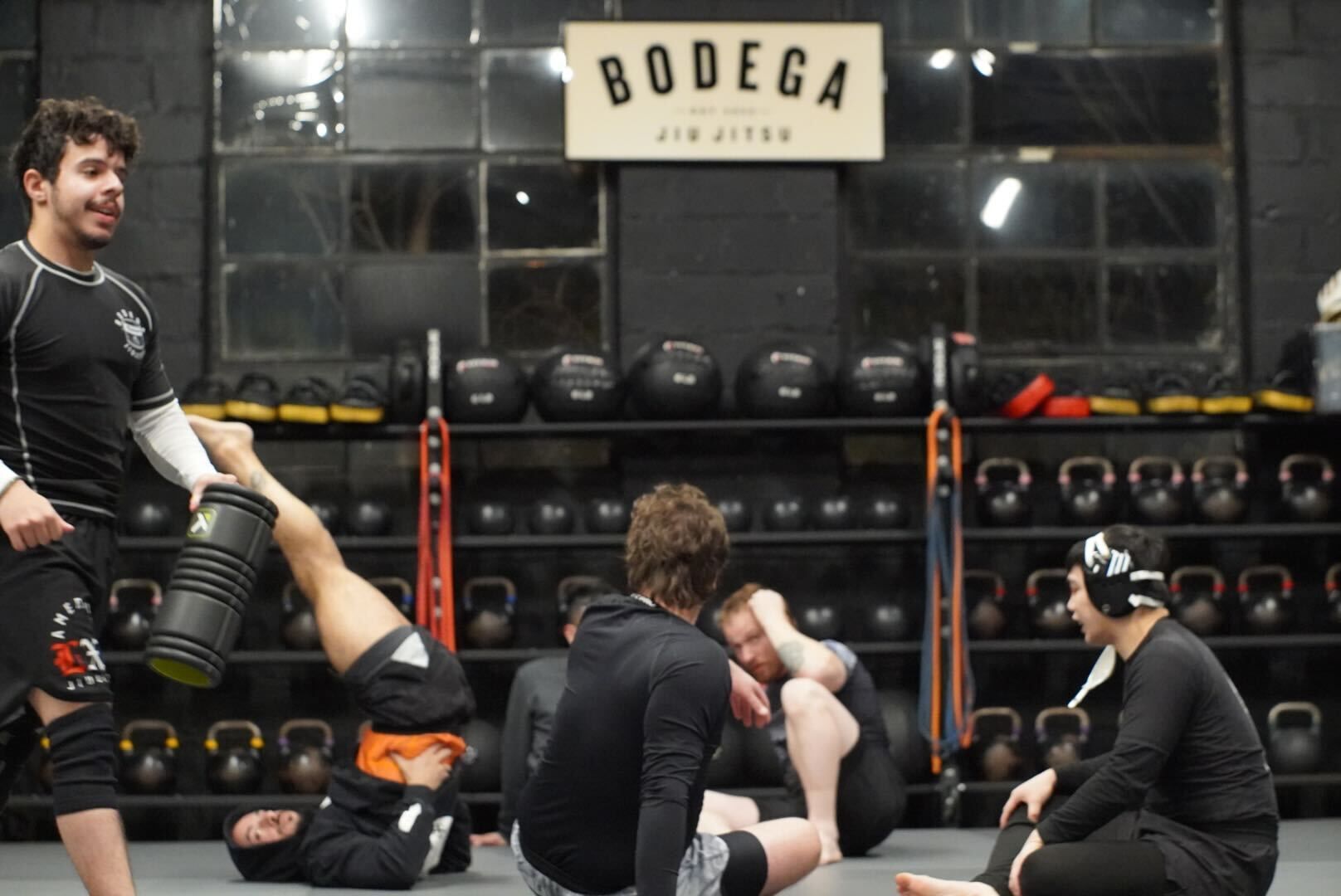
At Bodega Jiu-Jitsu, our adult grappling classes in Maplewood are designed to help you start where you are and progress steadily, whether your goal is weight loss, healthier joints, better conditioning, or simply finding a training routine you can stick with.
No experience needed—start with a free trial class at Bodega Jiu-Jitsu and see how accessible and welcoming Brazilian Jiu-Jitsu can be for adults of all levels. Bodega Jiu Jitsu